Introduction
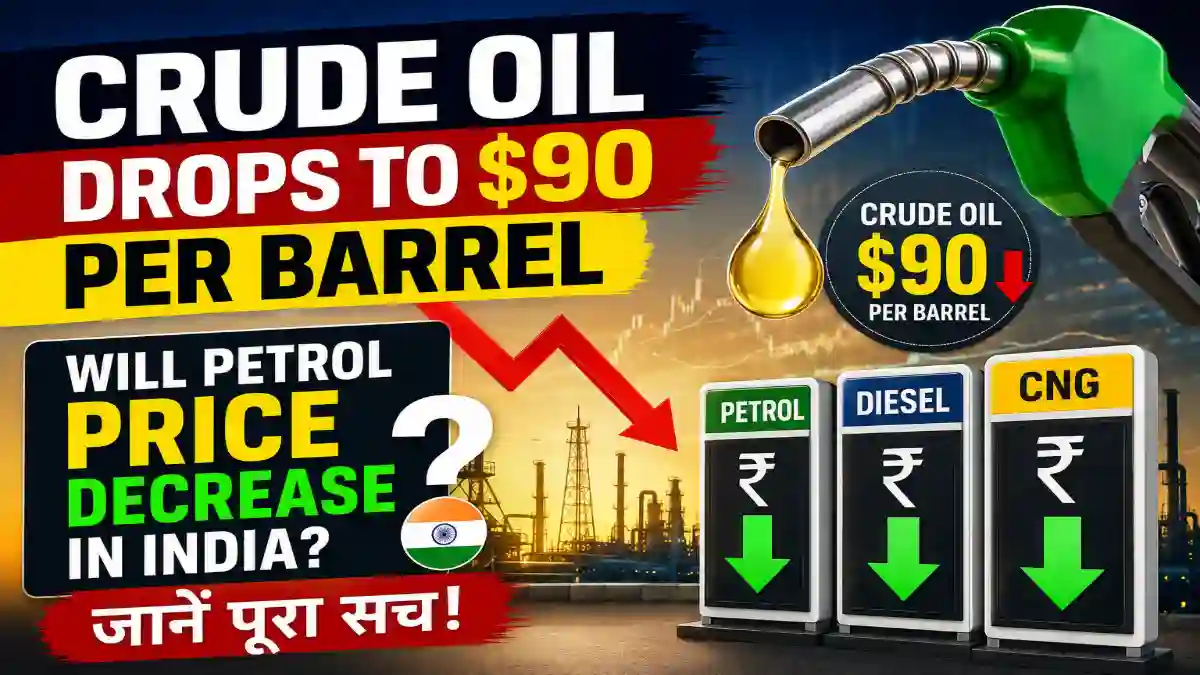
For millions of vehicle owners across India, looking at the daily fuel price in India has become a routine filled with anxiety. Recently, retail fuel markets saw sharp jumps, pushing prices past major psychological barriers. However, fresh global data shows that international Brent crude oil futures have slid down to trade around the $90 per barrel mark.
This drop from recent highs near $97 has triggered a massive question among commuters, transport operators, and businesses: Will petrol price today decrease in India after international crude oil drops to 90 dollars? Let us break down the ground reality of how Indian oil companies calculate prices, why immediate relief might not hit your local fuel station tomorrow, and what the latest fuel market news means for your pocket.
Crude at $90: The Real Math Behind Shifting Fuel Prices in India
The international oil market is riding a roller coaster. Just a week ago, severe tensions in West Asia and fears of supply blocks around the Strait of Hormuz pushed Brent crude closer to the $100 line. A cooling down of immediate panic, combined with weaker global demand data from large buyers like China, has pulled prices down to the $90 range.
However, a drop in international crude oil prices does not instantly translate into a cheaper petrol price hike reversal in India. India follows a dynamic fuel pricing system where state-run Oil Marketing Companies (OMCs) like Indian Oil (IOCL), Bharat Petroleum (BPCL), and Hindustan Petroleum (HPCL) are technically free to revise rates daily based on a 15-day rolling average of global prices.
The catch here is two-fold:
- The Rupee Multiplier Effect: India imports over 88% of its crude oil requirements and pays for it in US Dollars. The Indian Rupee has been under severe pressure, trading weak against the dollar. So, even if a barrel of crude drops to $90, buying that same barrel requires more rupees than it did a couple of years ago.
- Recovering Past Losses: OMCs did not fully pass on the entire burden of previous crude spikes to consumers immediately. Analysts note that even with crude dropping to $90, oil companies are trying to absorb past under-recoveries before cutting down the diesel price today or lowering petrol rates.
Ripple Effect: How $90 Crude reshapes Everyday Inflation and Household Budgets
When crude oil drops to 90 dollars, the direct impact on the common Indian citizen is tied to retail inflation. Fuel is a core commodity. A high petrol price today means common commuters spend a higher portion of their middle-class household budget just travelling to work.
More importantly, the diesel price today acts as the engine of the Indian economy. Almost all agricultural goods, essential items, and e-commerce deliveries move across states via diesel-powered trucks.
The Inflation Cycle: If diesel prices stay stubbornly high despite global crude corrections, freight rates remain elevated. This keeps the cost of vegetables, milk, and daily groceries high for the end consumer, making it harder for the Reserve Bank of India (RBI) to lower interest rates on home or car loans.
Regional Variations: What Petrol and Diesel Cost Across Major Indian Metros Today
Because of varying local taxes and Value Added Tax (VAT) applied by different state governments, fuel prices look entirely different depending on where you fill up your tank.
The table below outlines the retail fuel rates across major Indian metro cities following the recent market updates:
City | Petrol Price Today (per Litre) | Diesel Price Today (per Litre) |
|---|---|---|
New Delhi | ₹102.12 | ₹95.20 |
Mumbai | ₹111.21 | ₹97.83 |
Kolkata | ₹113.51 | ₹99.82 |
Chennai | ₹107.74 | ₹99.55 |
Bengaluru | ₹110.93 | ₹98.80 |
As visible, while New Delhi sits closer to the ₹102 mark, citizens in Mumbai and Kolkata pay significantly higher prices because of steeper state VAT percentages. Any potential price cut driven by $90 crude will benefit consumers unevenly based on these state taxes.
How Taxes and OMC Margins Control Your Fuel Bill
To understand when a price cut will happen, we have to look closely at the pricing architecture. The final retail price you pay at the fuel station consists of:
- Base Price: The cost of raw crude oil + refinery processing margins.
- Central Excise Duty: A fixed tax levied by the Central Government across India.
- Dealer Commission: The cut paid to the petrol pump owner.
- State VAT: A percentage tax applied by individual state governments.
Because the central excise and state VAT make up a massive chunk of the pump price, a decline in crude oil only affects the base price component. OMCs use periods when crude drops to $90 to repair their balance sheets. If crude stays stable or dips further below $90 for a consecutive 2 to 3 weeks, OMCs generally face pressure from the government to pass a relief cushion of ₹2 to ₹3 per litre down to the retail consumers.
Market Watch: What Energy Analysts Say About the $90 Crude Reality
Market experts maintain a cautious view of the current situation. While a drop to $90 per barrel is good news compared to the threat of $100 oil, the structural market remains tightly balanced. Leading brokerage firms like Emkay Global recently adjusted their average Brent crude price projection for the fiscal year to hover around the $90 mark due to ongoing inventory depletion and regional instabilities.
The consensus among energy analysts is that a massive price drop is unlikely right away. Instead of a sharp ₹5 or ₹6 price cut, consumers should expect a prolonged freeze in prices. The drop to $90 gives OMCs the breathing room to avoid any further petrol price hike for the next few months, which in itself is a form of stable relief for the market.
Smart Fuel Management: Practical Strategies to Protect Your Budget
Given that fuel prices are expected to remain consolidated around current levels with minor micro-fluctuations, smart consumers can take proactive steps to manage their transport budgets:
- Track CNG and EV Alternatives: Keep an eye out for a local CNG price update. If your daily running is high, transitioning to a CNG vehicle or looking into the Electric Vehicle (EV) ecosystem provides an excellent long-term hedge against erratic fossil fuel prices.
- Use Fuel Credit Cards: Many major Indian banks offer co-branded fuel cards with OMCs that give 3% to 5% savings back via surcharge waivers and reward points.
- Monitor Weekly Trends: Check reliable platforms like TodayPetrolPrice.in daily to track state-wise variations, especially if you manage a fleet or travel across state borders frequently.
Conclusion
To sum it up neatly: Yes, international crude oil dropping to 90 dollars per barrel is a highly positive indicator for the Indian economy, but do not expect an instant drop in your local petrol bills tomorrow morning. The combined impact of a weaker rupee, accumulated marketing losses of OMCs, and heavy fixed taxation means that this global drop will primarily serve to stabilize prices and prevent further hikes. If crude drops consistently below the $85-88 range and holds steady, retail price cuts will slowly find their way to the Indian fuel pumps.