Introduction
If you are a car or bike owner in India, your daily routine probably begins with a quick glance at the changing numbers at the local fuel pump. Fuel expenses take up a massive chunk of the monthly household budget for middle-class families. However, if you drive through the bustling streets of Mumbai, a sudden realization hits your wallet—filling up your tank here is noticeably more expensive than doing the same in New Delhi or the coastal state of Goa.
Have you ever wondered why identical fuel coming from the exact same oil refineries costs so differently across state lines? This variation is not an accidental glitch in the system. The disparity highlights the complex domestic tax networks, regional surcharges, and pricing strategies that govern the daily fuel price in India. Let us decode the economic factors that make Mumbai one of the costliest places in India to buy fuel.
Crude Oil to Retail Pump: How Daily Fuel Prices Are Calculated
The Indian fuel market operates under a system called dynamic fuel pricing. This means that the petrol price today and the diesel price today are updated every morning at 6:00 AM by state-run Oil Marketing Companies (OMCs). The baseline pricing depends heavily on global crude oil benchmarks (like Brent Crude) and the US Dollar to Indian Rupee (USD-INR) exchange rate since India imports more than 85% of its crude requirements.
When international crude oil markets face supply disruptions due to geopolitical tensions in the Middle East, a petrol price hike becomes inevitable at the national level. However, global market changes affect every Indian state equally. The primary reason for different price tags across cities is the localized state tax structure. When crude oil arrives at Indian ports, the central government adds a flat excise duty. After that, individual state governments slap on their own Value Added Tax (VAT) and local cess charges, creating a massive difference in retail costs.
How Mumbai’s High Fuel Rates Impact Daily Commuters
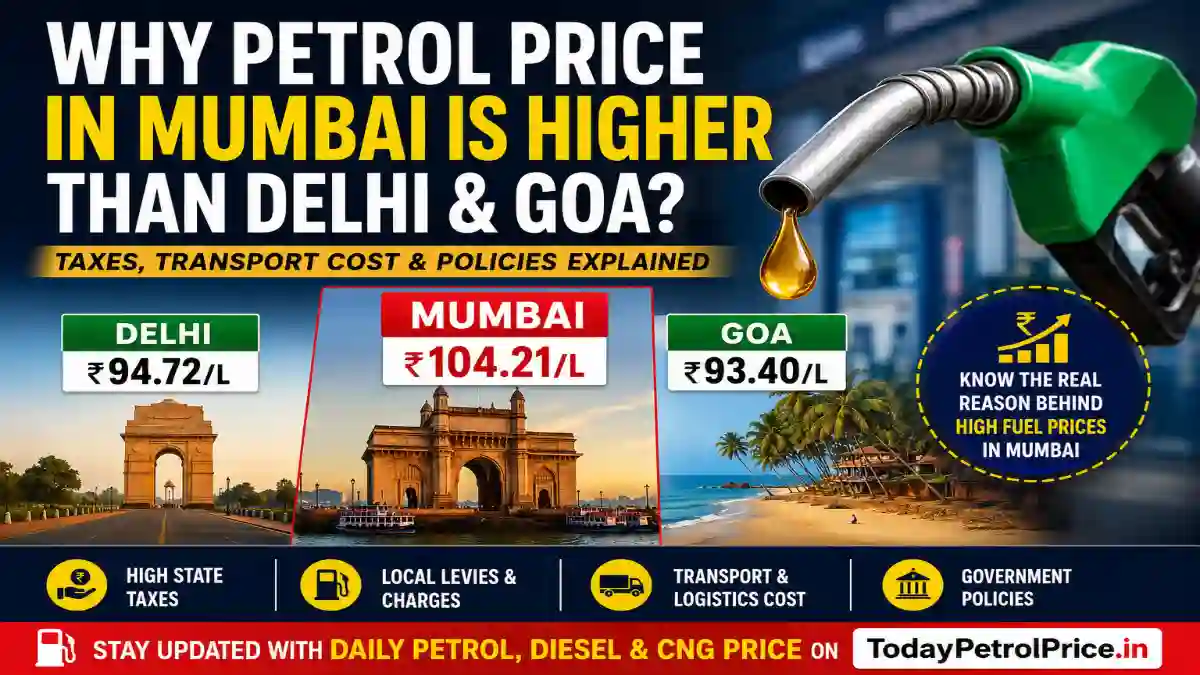
When petrol prices cross psychological barriers in major metropolitan areas, the financial ripple effect disrupts the entire local economy. For a daily commuter in Mumbai, a difference of Rs 9 to Rs 12 per litre compared to Delhi translates into thousands of rupees in extra monthly expenses.
Higher Fuel Costs ──> Increased Freight Charges ──> Costlier Vegetables & Daily Essentials
The burden does not stop at personal vehicle owners. Higher diesel rates directly inflate the operating costs of local transport trucks, tempos, and delivery fleets. Consequently, wholesale merchants pass these expenses down to final buyers. This means a steep petrol price hike in Maharashtra indirectly makes everyday items like vegetables, milk, and online delivery packages more expensive for a Mumbaikar than a resident of Delhi or Goa.
Mumbai vs Delhi vs Goa: Fuel Price Comparison Across States
To understand how wide this gap actually stands, let us look at the retail fuel prices across major Indian cities and states. The variation reveals a clear divide between high-tax states and regions with structured subsidies or lower revenue dependencies on petroleum.
City / State | Average Petrol Price (Per Litre) | Average Diesel Price (Per Litre) | Primary Pricing Driver |
|---|---|---|---|
Mumbai (Maharashtra) | Rs 104.21 | Rs 92.15 | High State VAT + Surcharge |
New Delhi | Rs 94.72 | Rs 87.62 | Lower UT VAT Structure |
Goa (Panaji) | Rs 104.19 | Rs 90.07 | Relaxed Tourism Fuel Taxes |
Bengaluru (Karnataka) | Rs 102.86 | Rs 88.94 | Moderate State Slabs |
Chennai (Tamil Nadu) | Rs 100.75 | Rs 92.34 | Standard Southern State VAT |
Kolkata (West Bengal) | Rs 103.94 | Rs 90.76 | High Eastern State Cess |
While Mumbai stands at the higher end of the spectrum, New Delhi manages to keep retail prices lower due to competitive tax rates implemented by the Union Territory administration. Goa historically maintained a highly relaxed tax bracket to support its local tourism and hospitality infrastructure, though recent adjustments have brought its basic retail margins closer to national averages.
Government and OMC Role
Retail pricing involves a multi-stage process where three public sector giants—Indian Oil Corporation Limited (IOCL), Bharat Petroleum Corporation Limited (BPCL), and Hindustan Petroleum Corporation Limited (HPCL)—play the lead role. These OMCs purchase crude, process it at domestic refineries, and establish the base price.
The central government levies a uniform excise duty across all states. The real divergence begins when state administrations apply their local calculations. For example, the Maharashtra government levies a combination of percentage-based VAT along with fixed additional state collections per litre to fund specific infrastructure projects.
Furthermore, transportation costs or "freight adjustments" add minor variations. Refineries located far away from coastal docking points face higher inland transport pipeline costs, which are added directly to the local pump prices.
Expert View
Energy market analysts point out that the wide difference in fuel rates reveals how much state governments rely on petroleum products for local revenue collection. Because fuel and alcohol do not fall under the uniform Goods and Services Tax (GST) regime, state administrations retain complete authority to alter VAT rates whenever they need to balance their fiscal budgets.
"Maharashtra possesses highly advanced infrastructure demands, which require massive capital investments. Since petroleum acts as a direct source of liquid cash flow for state treasuries, lowering fuel taxes becomes a difficult choice for local revenue boards."
This economic reality ensures that unless a nationwide consensus brings petroleum products under the single GST national framework, consumers will continue to witness a significant price gap between different states.
What Consumers Should Do
While you cannot control state tax policies or global crude oil supply lines, smart financial planning can minimize the impact on your monthly budget:
1.Leverage Fuel Co-branded Credit Cards:Immediate Savings. Switch your fuel payments to specialized banking cards offering fuel surcharge waivers. Leading banks offer points that translate to 4% to 5% savings per tank fill.
2.Monitor Live Prices Before Long Trips:Smart Planning. If you live near border lines (like Thane-Mumbai borders or Delhi-Noida borders), check a reliable online platform for a quick CNG price update or local fuel drop before refuelling.
3.Transition Part of Daily Commutes to EVs:Long-term Strategy. For short inner-city travel, calculate your potential savings by using an interactive digital calculator. Shifting short runs to electric options reduces your dependency on changing fuel pumps.
Conclusion
The clear difference between fuel rates in Mumbai, Delhi, and Goa highlights the impact of regional taxation over global crude trends. While OMCs maintain a uniform production base, local state VAT and infrastructure surcharges determine the final price at the pump. Until structural tax revisions or GST integration takes place, checking the fuel market news daily remains the best way for vehicle owners to navigate changing fuel costs.