Introduction
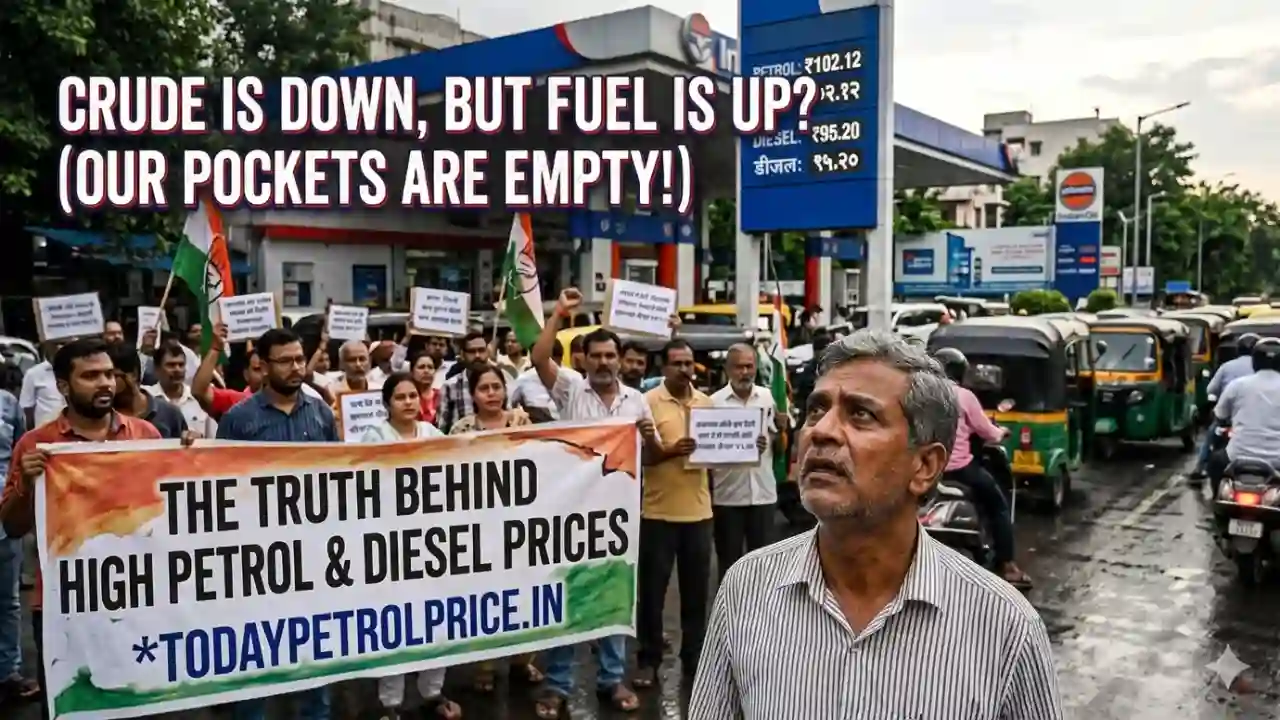
The political heat in India has intensified following a series of sudden revisions in retail fuel prices. On Tuesday, Congress President Mallikarjun Kharge launched a sharp attack on the central government over the rising cost of transportation fuels. Citing historical official data, the opposition leader questioned why the common citizen is facing a heavy financial burden at the pumps when international crude oil prices are significantly lower today than they were twelve years ago. This debate comes right on the heels of back-to-back retail fuel hikes executed by domestic oil marketing companies (OMCs), pushing the standard petrol price today past the landmark 100 rupees threshold in a majority of Indian metropolitan cities.
Why Fuel Prices Are Changing
To understand the core of the issue raised by Mallikarjun Kharge, one must look at the mathematical contrast between 2014 and 2026. Taking to his official handle on social media platform X, Kharge highlighted data from the Press Information Bureau (PIB) to establish a baseline.
Exactly twelve years ago, on May 26, 2014, when the current central government originally assumed office, the international crude oil price for the Indian basket stood at an elevated $108.05 per barrel. At that time, the US Dollar to Indian Rupee (USD-INR) exchange rate was hovering around ₹58.59. Fast forward to late May 2026, and global crude oil prices have relaxed, trading comfortably below the $99 per barrel mark.
Logically, a drop in basic raw material costs should translate into a cheaper final product. However, retail fuel counters across India are telling a completely contradictory story. Instead of a price drop, petrol has registered a staggering 42.8% increase, while the diesel price today reflects a monumental 67.9% hike compared to the 2014 base rates. The central mystery for the ordinary commuter is simple: if the underlying crude oil is cheaper, why is the finished product breaking household budgets?
Petrol and Diesel Price Impact
The immediate impact of a petrol price hike is never limited to vehicle owners alone. Because diesel is the primary fuel powering India’s massive commercial logistics network, agricultural machinery, and public transport systems, a hike acts as a compounding inflationary force.
When fuel costs go up, the overhead operational cost for transport trucks escalates proportionally. This extra expense is naturally passed down the supply chain, ultimately inflating the retail prices of daily consumer goods, milk, seasonal vegetables, and essential medicines. Kharge emphasized this reality by noting that every single economist understands how heavily fuel inflation dampens household savings, squeezing the purchasing power of lower- and middle-income families.
State-wise Situation
Due to differing local value-added taxes (VAT) and freight costs, retail fuel metrics vary notably across states. Following the latest series of countrywide revisions—which saw a sharp collective increase of ₹2.61 to ₹2.71 per litre in less than a fortnight—major Indian metropolitan areas show heavily altered price boards.
| City | Petrol Price Today (per Litre) | Diesel Price Today (per Litre) |
|---|---|---|
| Delhi | ₹102.12 | ₹95.20 |
| Mumbai | ₹108.43 | ₹99.75 |
| Bengaluru | ₹104.90 | ₹91.60 |
| Chennai | ₹103.80 | ₹96.25 |
| Kolkata | ₹105.50 | ₹97.10 |
The situation is further complicated by a parallel CNG price update in the national capital region, where compressed natural gas received a ₹2 per kg upward correction, resting at ₹83.09 per kg. This simultaneous push across fossil fuels and green alternatives has multi-city commuters looking toward the cost dynamics of the growing electric vehicle (EV) sector. For detailed local metrics, users can refer to our daily regional directories covering the latest fuel price in India.
Government and OMC Role
The structural disconnect between international crude adjustments and domestic retail rates boils down to tax architectures and corporate strategy. In India, retail prices are governed by a deregulated pricing mechanism where state-owned oil marketing companies like Indian Oil Corporation (IOCL), Bharat Petroleum (BPCL), and Hindustan Petroleum (HPCL) technically adjust rates daily based on a 15-day rolling average of international benchmark prices.
However, the major cushion separating crude costs from pump rates consists of central excise duties and state-level VAT. Over the last decade, whenever global crude prices dropped, governments periodically absorbed the margin by hiking excise structures rather than passing the complete financial relief down to retail outlets. Furthermore, OMCs use high-margin periods to offset previous financial losses incurred when global crude spikes were left unpassed due to macro-economic or electoral considerations.
Expert View
Independent energy market specialists and senior analysts at TodayPetrolPrice.com highlight that tracking crude in isolation does not paint the absolute picture. The depreciation of the Indian Rupee against the US dollar over the last decade plays a structural role. While crude oil went from $108 down to under $99, the Indian Rupee fell from roughly ₹58 to beyond ₹83 against the greenback. Because India imports over 85% of its crude oil requirements and pays globally in USD, the currency depreciation cancels out a significant portion of the crude price decline.
Nevertheless, specialists acknowledge that the current retail margin cushion enjoyed by both tax collectors and corporate refiners remains exceptionally high, lending weight to the opposition's political stance against heavy government "profiteering" during periods of global commodity relaxation.
What Consumers Should Do
With the fuel market news signaling volatile pricing blocks ahead, retail consumers must adjust daily habits to safeguard personal finances:
- Optimize Vehicle Usage: Use public transit networks or organize carpools for predictable office commutes.
- Maintain Vehicle Health: Ensure correct tire pressure and regular engine tuning, which can collectively improve overall fuel efficiency by up to 10-15%.
- Leverage Digital Rewards: Utilize co-branded fuel credit cards or loyalty programs offered by primary OMCs to secure cashbacks and structural fuel waivers.
- Explore Alternate Fueling: For high-mileage urban commuters, calculating the long-term cost benefits of shifting toward hybrid systems or dedicated EV platforms is becoming increasingly viable.
Conclusion
The friction between falling international raw crude metrics and climbing retail costs remains a point of high economic discussion in India. While global energy dynamics suggest a softening in upstream crude cost structures, domestic retail realities remain heavily anchored by fiscal taxation demands and currency adjustments. As long as the tax component comprises a dominant portion of the pump price, the common consumer will have to navigate stiff retail rates, ensuring that fuel inflation continues to occupy center stage in national economic policy debates.