Introduction
The Indian automotive landscape is witnessing a massive structural shift. For years, the high upfront cost of electric vehicles (EVs) pushed budget-conscious buyers back toward internal combustion engines. However, Tata Motors has disrupted this dynamic by introducing the Battery-as-a-Service (BaaS) ownership model for the newly launched Tata Tiago EV facelift.
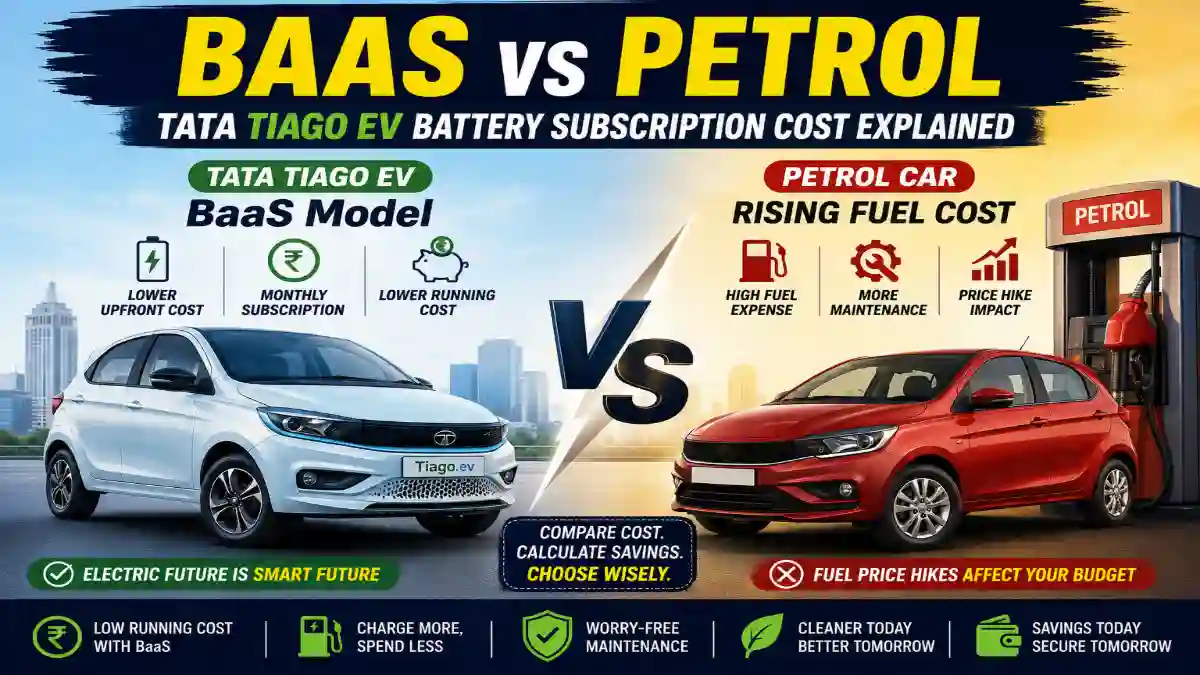
By separating the cost of the car from the cost of the battery, Tata has brought down the entry-level price of the Tiago EV to an astonishing Rs 4.69 lakh (ex-showroom). This puts it head-to-head with entry-level petrol hatchbacks. But with a battery rental charge of Rs 2.60 per km, the real question for Indian car buyers is simple: Does BaaS actually save you money compared to a standard petrol car, or is it a clever marketing wrap?
Let us dive deep into the math, compare it with regular fuel price in India, and analyze whether this model suits your daily commute.
Why Fuel Prices Are Changing and Driving EV Innovation
The core driver behind this alternative ownership model is the unpredictable nature of the traditional fuel market news. The petrol price today and diesel price today continue to stay highly volatile across Indian cities, heavily impacted by global crude oil fluctuations, standard refinery margins, and local taxation.
With petrol hovering around the Rs 100 per liter mark in most states, running a traditional internal combustion vehicle has become a costly affair for ordinary middle-class households. Even though the CNG price update tracks offer some relief, limited network availability and regular price updates keep buyers on their toes.
To bypass this constant fuel price anxiety, manufacturers are shifting toward creative financial engineering like BaaS. By reducing the upfront premium of buying an electric car, they are trying to match the initial price tag of petrol cars while capping your running costs.
Petrol and Diesel Price Impact vs. Tiago EV BaaS Math
To understand the economic impact on your pocket, we have to contrast the traditional petrol running costs against the new Tiago EV BaaS structure.
The Upfront Cost Difference
Normally, the outright purchase of the base Tata Tiago EV Smart variant (19.2 kWh) costs Rs 6.99 lakh (ex-showroom). Under the BaaS model, the upfront price drops to Rs 4.69 lakh.
- You save exactly Rs 2.30 lakh upfront.
- This translates to smaller down payments, lower loan amounts, and drastically reduced monthly EMIs.
The Running Cost Battle
Now, let us calculate the regular monthly expenses.
If you drive a standard petrol hatchback that gives an average mileage of 16 km/l in city traffic, and petrol costs roughly Rs 100 per liter, your fuel cost is Rs 6.25 per km.
With the Tiago EV BaaS model, your costs are split into two:
- The Battery Rental: Rs 2.60 per km.
- The Charging Cost (Electricity): A 19.2 kWh battery gives a real-world range of around 140–150 km. At an average domestic electricity slab of Rs 7 to 8 per unit, a full charge takes roughly 20 units, costing around Rs 150. This means the electricity cost is roughly Rs 1.00 per km.
Combined, the total running cost under Tiago EV BaaS comes to approximately Rs 3.60 per km ($2.60 + 1.00$).
The Cost Verdict: You save roughly Rs 2.65 per km compared to a petrol car. However, you must track if there is a minimum monthly running commitment mandated by the company, which can sometimes impact low-mileage users.
State-wise Situation and On-Road Impact
Because road taxes, registration structures, and fuel price in India vary drastically across regional boundaries, the viability of BaaS changes from state to state.
- Delhi: With highly subsidized EV registration policies and high petrol prices exceeding Rs 95, the upfront saving of Rs 2.30 lakh combined with zero road tax makes the Tiago EV BaaS an incredibly lucrative option for regular office-goers.
- Mumbai: Maharashtra carries some of the highest petrol prices in the country, often crossing Rs 104 per liter. Here, shifting to a Rs 3.60 per km running cost model provides massive financial relief to daily commuters tackling long city traffic jams.
- Bengaluru: Known for high road taxes on premium vehicles, buying the Tiago EV at an ex-showroom base of Rs 4.69 lakh keeps the initial registration wrapper very manageable for tech professionals.
- Chennai & Kolkata: In these metro pockets, where public charging grids are growing steadily, the low entry barrier allows middle-class families to look at the Tiago EV as a practical secondary city vehicle.
Government and OMC Role in the Fuel Transition
The Indian government's continuous push toward clean energy via lower GST rates on EVs (5% compared to 28% on petrol cars) acts as the backbone for programs like BaaS. Simultaneously, Public Sector Oil Marketing Companies (OMCs) like IOCL, BPCL, and HPCL are fast-tracking the installation of EV fast-charging units at existing petrol pumps.
As charging stations become as common as traditional fuel bays, the psychological barrier of "range anxiety" fades. This allows alternative setups like battery rentals to flourish because finding an electricity source becomes effortless.
Expert View: The Break-Even Analysis
From a pure analytical standpoint, the BaaS model is a game of running distance. Let us look at the mathematics of the upfront savings of Rs 2.30 lakh.
At a rental cost of Rs 2.60 per km, you would need to drive exactly 88,461 kilometers ($2,30,000 \div 2.60$) before the total subscription fees you pay equal the exact amount you saved upfront.
Total Kilometers to Break Even = Upfront Saving / Per-KM Rental Fee
                               = 2,30,000 / 2.60
                               = 88,461 km
For a typical urban driver covering roughly 10,000 km a year, it will take nearly 8 to 9 years to hit that mark. Since a large percentage of car owners choose to upgrade or sell their vehicles within 6 to 7 years, the BaaS model ensures they keep that initial Rs 2.30 lakh in their bank accounts or investments from day one.
Is the BaaS Model Right for You? A Practical Buyer's Checklist
Before visiting the showroom to capitalize on this drop from the standard petrol price hike worries, assess your driving patterns:
- Choose BaaS if: Your daily running is moderate (30 to 50 km), you want to minimize your initial loan burden, plan to keep the car for less than 7 years, and want protection against battery degradation risks.
- Choose Outright Purchase if: You are a very high-mileage driver (fleet operators or commercial usage crossing 80–100 km daily) or plan to hold onto the vehicle for over a decade.
Conclusion
The Tata Tiago EV with Battery-as-a-Service changes the rules of car ownership in India. It successfully eliminates the steep entry premium of electric vehicles, offering a modern, feature-loaded automatic hatchback at the cost of a basic petrol alternative. While you do pay a recurring per-kilometer rental, your cumulative expenses still stay lower than matching the regular diesel price today or petrol price bills. It is a highly practical, budget-friendly gateway for families looking to shield themselves from unpredictable fossil fuel market trends.