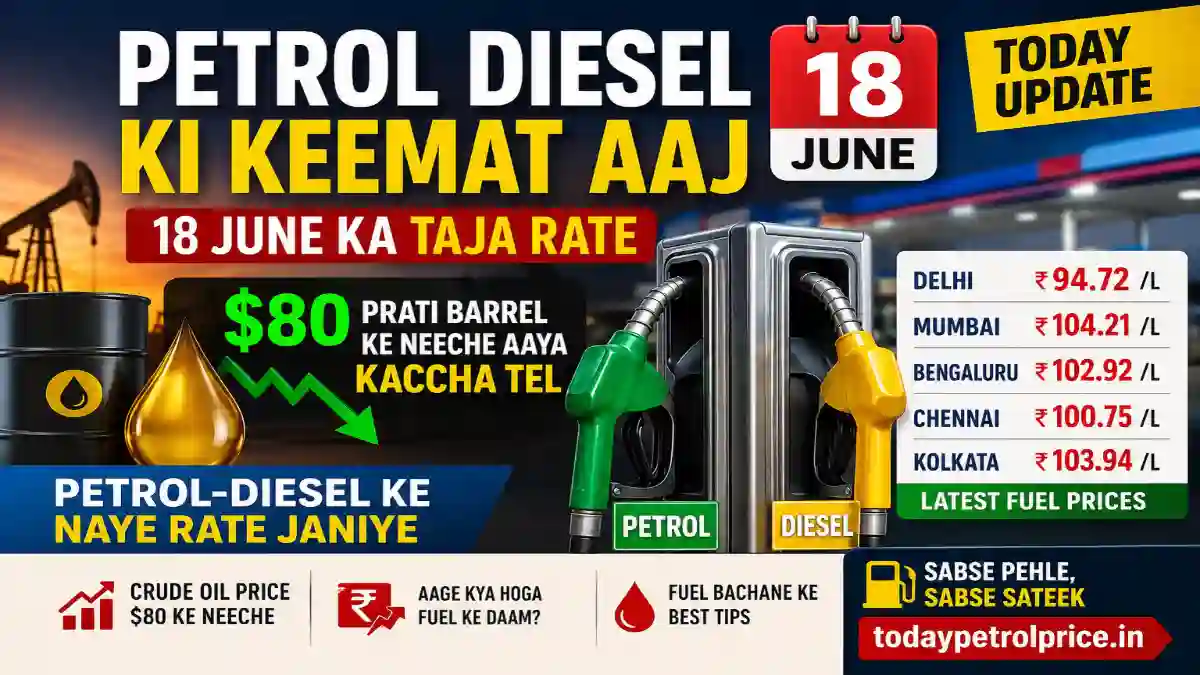
Petrol Diesel Ki Keemat Aaj, 18 Jun: $80 Prati Barrel Ke Neeche Aa Gaya Kaccha Tel, Petrol-Diesel 18 June Ka Taja Rate
Indian consumers looking at their daily fuel market news have something crucial to notice this morning. The global oil market is witnessing a major shift as international crude prices have slipped below the crucial benchmark of $80 per barrel.
This drop in the global energy market comes at a time when retail consumers are tracking every minor fluctuation. On June 18, oil marketing companies (OMCs) released the latest domestic fuel price today update, keeping retail rates steady in most parts of the country despite international volatility.
For everyday commuters, this stability offers short-term relief, but the underlying movement in the global oil market remains highly significant for the broader Indian economy. Let us dive deep into what this crude drop means for your pocket.
Global Crude Oil Market Bags Break: Prices Kyon Badal Rahe Hain?
The primary reason behind the latest shift in the fuel market news is the sudden easing of international crude prices. Brent crude oil benchmarks recently fell below $80 per barrel due to multiple macroeconomic factors working together.
- US Inventory Build-up: Higher than expected crude stockpiles in the United States have created a short-term supply buffer, cooling down immediate global demand pressures.
- Economic Slowdown Fears: Major manufacturing economies, including parts of Europe and Asia, are showing signs of slower industrial growth, lowering their energy consumption projections.
- OMCs Decision Matrix: In India, state-run Oil Marketing Companies like Indian Oil Corporation (IOCL), Bharat Petroleum (BPCL), and Hindustan Petroleum (HPCL) review retail prices based on a 15-day rolling average of international benchmark rates.
Because retail pricing involves complex government taxes, processing margins, and dealer commissions, local fuel rates do not always drop instantly when global crude falls. However, extended periods of sub-$80 crude generally build strong pressure for a eventual retail price revision.
Aam Logon Par Kya Padega Asar: Inflation And Your Pocket
Whenever there is a significant movement in the fuel price in India, its ripples are felt across multiple consumer segments. Fuel is not just a commuter expense; it is the driving engine of logistical supply chains.
With crude remaining lower, transport operators experience stable operating costs, preventing immediate hikes in freight charges. This stability acts as a shield against sudden inflation in daily essentials like green vegetables, milk, and seasonal fruits that travel long distances to reach urban mandis.
If global crude sustains this downward trajectory below $80, a future petrol price hike becomes highly unlikely. Instead, industry analysts suggest that consumers might soon see a marginal price cut, which could boost retail spending power before the upcoming festive seasons.
Shehar-Wise Petrol Diesel Rate 18 June Today: Metro City Breakdown
Local taxes, state-level VAT, and freight costs create differences in retail pricing from one state to another. Here is a clear look at the fresh retail rates across major Indian metro hubs for June 18:
City Name | Petrol Price Today (Per Litre) | Diesel Price Today (Per Litre) | Change / Status |
|---|---|---|---|
Delhi | ₹94.72 | ₹87.62 | Stable |
Mumbai | ₹104.21 | ₹92.15 | Stable |
Kolkata | ₹103.94 | ₹90.76 | Stable |
Chennai | ₹100.75 | ₹92.34 | Stable |
Bengaluru | ₹102.84 | ₹88.95 | Marginal State Adj. |
While major metros show a flat pricing trend today, small variations can be observed in tier-2 and tier-3 towns depending on localized dealer commissions and transport distances from regional oil depots.
The Role Of OMCs And Indian Government Fuel Policy
India relies heavily on imports to meet over 85% of its domestic crude oil requirements. This heavy dependence makes our domestic retail market sensitive to global geopolitical tensions and supply route disruptions.
The Indian government, alongside state-run OMCs (IOCL, HPCL, BPCL), follows a deregulated pricing mechanism on paper. However, in practice, OMCs balance corporate profits with consumer welfare, often absorbing high global costs or retaining margins during periods of lower crude to offset previous losses.
Recent policy updates indicate that OMCs are recovering their past marketing losses steadily. With crude staying comfortably under the $80 cushion, these corporations are finding themselves in a financially sound position to sustain steady prices without passing any immediate burden onto common citizens.
Market Expert Views On Crude Oil Volatility
Energy market analysts suggest that the current drop below $80 per barrel is a temporary relief window rather than a permanent downward trend. Seasonal summer travel demands in the West and OPEC+ supply management strategies could pull prices back up over the coming quarter.
"As long as crude sits comfortably between $75 and $80, Indian oil companies remain in a comfortable sweet spot. This stability helps control fiscal deficits and provides the government room to manage economic growth smoothly without worrying about immediate imported inflation."
Consumers should monitor how long this sub-$80 cycle persists. If crude averages low throughout the month, a structural retail price correction could become a realistic possibility for Indian vehicle owners.
Near-Term Outlook: What to Expect Next Week
Looking ahead, the market expects crude prices to consolidate around the $78-$82 range. A major upward spike is unlikely unless fresh geopolitical tensions emerge in key oil-producing regions or shipping channels.
For Indian consumers, this translates into continued price stability over the next couple of weeks. OMCs are expected to maintain status quo on retail petrol and diesel rates, giving consumers a predictable window to budget their monthly transport expenses cleanly.
Conclusion
The drop of global crude oil below $80 per barrel brings a highly positive signal for the Indian fuel market news ecosystem. While retail rates for June 18 remain steady across major cities, the ease in global pressure ensures that consumers are safe from any sudden petrol price hike for now.