Why Indians Are Running Toward EVs After Recent Petrol Diesel Hikes
The Indian middle class has always been value-conscious. We don't just buy a vehicle; we calculate its "mileage" even before we look at the color. However, in the last few weeks, the conversation at dinner tables and office water coolers has shifted from "Which car gives the best mileage?" to "Is it time to go electric?"
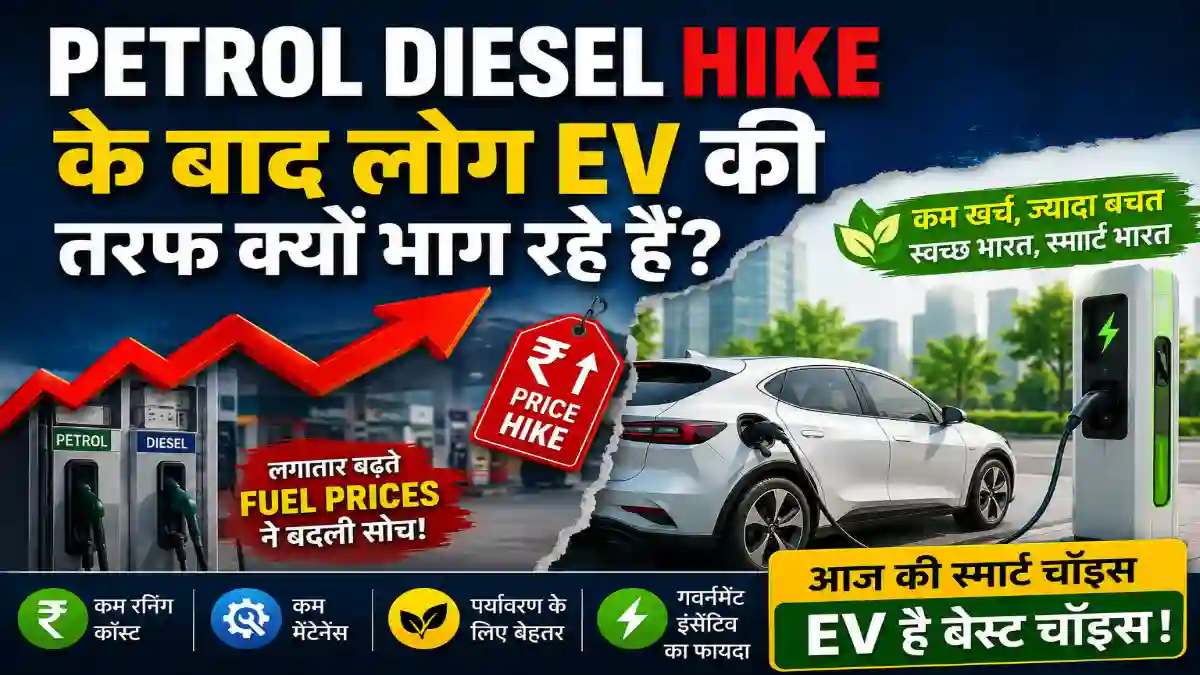
With the petrol price today touching record highs in cities like Mumbai and Kolkata, the financial burden on a common man's pocket has become unsustainable. This isn't just about a few paise anymore; it is a fundamental shift in how India moves. At TodayPetrolPrice.in, we are seeing a record number of users searching for alternatives as traditional fuel costs burn a hole in their monthly savings.
Latest Update: The Shock of May 2026
In May 2026, the Indian fuel market witnessed a series of sharp hikes. Over a span of just 11 days, petrol prices were hiked by nearly ₹7.50 per liter, while diesel followed a similar trajectory. In Kolkata, petrol has surged past ₹110 per liter, while Mumbai remains one of the most expensive metros for vehicle owners.
Even the "common man's fuel," CNG, hasn't been spared. Recent CNG price updates show a jump of ₹6 per kg in Delhi alone, bringing the price to approximately ₹83.09/kg. This triple-hit of petrol, diesel, and CNG hikes has left consumers with very few places to hide, making Electric Vehicles (EVs) the only logical exit strategy.
Why Fuel Prices Are Changing
The primary culprit remains the volatile global crude oil market. With Brent crude hovering between $105 and $110 per barrel due to geopolitical tensions in the Middle East, Indian Oil Marketing Companies (OMCs) are under immense pressure.
Currently, OMCs like IOCL, BPCL, and HPCL are reportedly absorbing losses of nearly ₹550 crore per day to prevent a complete price explosion at the pumps. However, they cannot hold the line forever. These "under-recoveries" eventually lead to calibrated price hikes that we see reflected in our daily fuel bills.
Petrol and Diesel Price Impact: The Common Man's Struggle
When the diesel price today goes up, it’s not just the SUV owner who pays more. Diesel is the backbone of India’s logistics. Everything from the milk delivered at your doorstep to the vegetables in the local mandi travels on diesel trucks.
A hike in diesel prices leads to "cascading inflation." This is why your grocery bill has gone up by 10-15% in the last month. For a daily commuter who travels 40 km to work, a ₹7-8 hike in petrol means an additional monthly expense of ₹1,500 to ₹2,000—money that would have otherwise gone into savings or education.
State-wise Situation: A Tale of Different Prices
The impact of the petrol price hike is not uniform across India due to varying Value Added Tax (VAT) and freight charges.
City | Petrol Price (Approx) | Diesel Price (Approx) |
|---|---|---|
Mumbai | ₹111.18 | ₹97.83 |
Kolkata | ₹113.51 | ₹99.82 |
Bengaluru | ₹110.89 | ₹98.80 |
Chennai | ₹107.77 | ₹99.55 |
New Delhi | ₹102.12 | ₹95.20 |
As seen above, residents in Mumbai and Kolkata are facing the maximum heat, which explains why EV registration numbers in these regions are seeing a 2x jump compared to last year.
The Great EV Shift: Why Now?
Why are people suddenly "running" toward EVs? It’s a mix of math and mindset.
- Running Cost: A petrol car costs roughly ₹7-9 per km to run. A Tata Tiago EV or an MG Comet costs less than ₹1.50 per km if charged at home. For a high-mileage user, the EV pays for its "premium price" within 3 years.
- Maintenance: With fewer moving parts (no engine, no gearbox, no oil filters), the service cost of an EV is nearly 60% lower than an Internal Combustion Engine (ICE) vehicle.
- Better Options: In 2026, we are no longer limited to expensive luxury EVs. With the launch of affordable electric hatchbacks and scooters, the entry barrier has dropped significantly.
- Charging Infrastructure: While still developing, the sight of a "charging station" at malls, parking lots, and highways has reduced the "range anxiety" that used to haunt potential buyers.
Government and OMC Role
The Indian government is actively pushing the "EV Shield" to reduce our dependence on oil imports. By providing subsidies under schemes like FAME and offering tax benefits on EV loans (Section 80EEB), the state is making it clear: the future is electric. On the other side, OMCs are also pivoting, installing thousands of EV charging points at existing petrol pumps to stay relevant in a changing market.
Expert View: Is the Shift Permanent?
As a fuel price analyst, I believe we are at a "tipping point." Historically, whenever petrol prices crossed a certain psychological barrier (like ₹100), people looked at CNG. But now, with CNG prices also climbing, the "safety net" of gas-powered vehicles is thinning.
The current fuel market news suggests that as long as global crude remains above $100, the pressure on the Rupee and local fuel rates will continue. This makes the EV not just an "eco-friendly" choice, but a "wallet-friendly" necessity.
What Consumers Should Do
If you are planning to buy a new vehicle today, ask yourself these three questions:
- Is my daily run more than 30 km? If yes, an EV will save you lakhs over 5 years.
- Do I have a dedicated parking spot with a power socket? This is the most critical factor for EV ownership.
- Is this my only car? If you frequently go on 500+ km road trips to remote areas, a Hybrid or a very efficient Diesel might still be a safer bet for now.
Conclusion
The recent petrol price today is more than just a number; it’s a catalyst for change. India is rapidly moving away from the "fill it, shut it, forget it" petrol era to the "plug it, charge it, save it" electric era. While the initial cost of an EV remains high, the spiraling costs of petrol and diesel are making the math work in favor of batteries. The road ahead is silent, green, and definitely electric.