Introduction
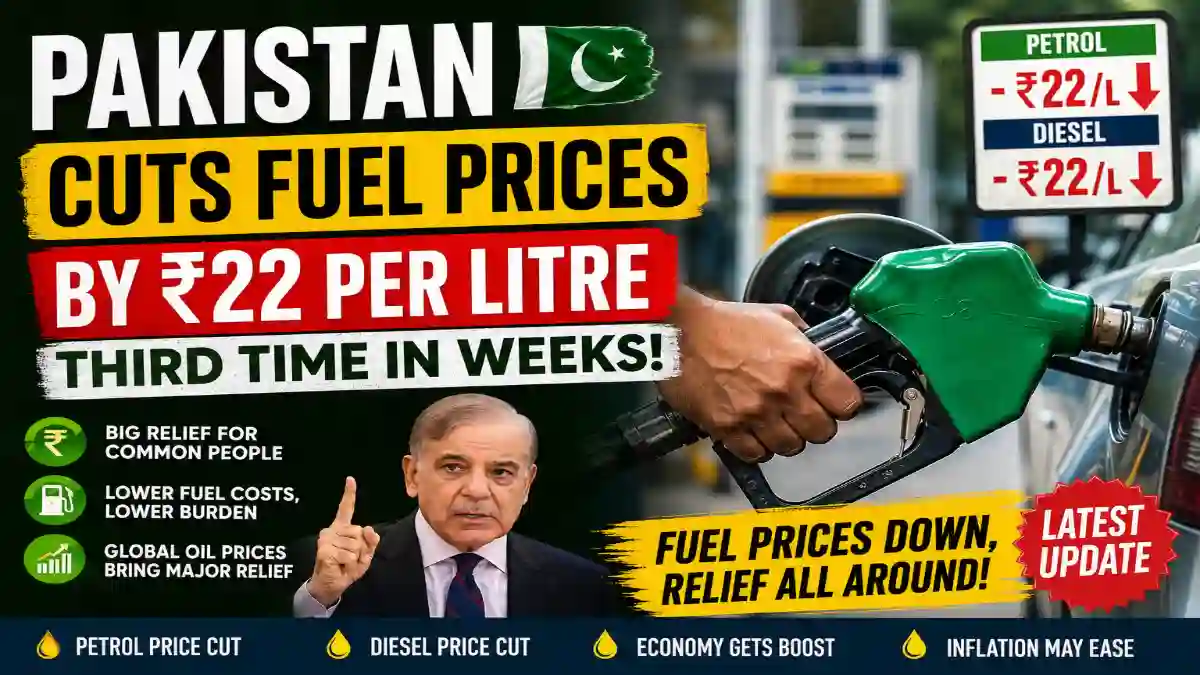
Volatilities in the South Asian energy market are keeping consumers and policymakers on their toes. In a unexpected move that has caught regional analysts by surprise, the Pakistani government announced a massive reduction in domestic fuel costs. Retail rates for both petrol and diesel dropped by ₹22 per litre. This marks the third consecutive downward revision in recent weeks for our neighboring nation.
While Pakistani commuters are celebrating this sudden economic relief, the development has triggered intense discussions across the border. In India, vehicle owners and businesses are watching closely. Everyone is asking the same burning question: If global factors are allowing a neighboring country to slash rates so drastically, can we expect a change in the petrol price today or diesel price today at home? Understanding the underlying market mechanics helps clarify what this means for Indian pockets.
Why Fuel Prices Are Changing
The fundamental driver behind Pakistan's sharp rate cuts is a noticeable cooling down of international crude oil prices. After weeks of geopolitical friction in West Asia that restricted supply routes through the Strait of Hormuz, crude futures eased by nearly 2% over the weekend. Global benchmarks like Brent crude dropped toward the $90–$91 per barrel mark as talks regarding temporary regional ceasefires progressed.
Furthermore, Pakistan reviews its retail fuel rates weekly, reflecting global market shifts almost immediately. Between early March and mid-May, the country experienced staggering historic highs, with diesel peaking above ₹520 per litre locally due to the global energy crisis. This latest reduction represents a partial correction as global supply pressures ease, allowing their government to pass on relief to a highly inflation-weary public.
Petrol and Diesel Price Impact
For Indian consumers, checking the fuel price in India has become a stressful routine. While Pakistan is cutting rates from highly inflated levels, India has faced an entirely different trajectory. After a prolonged freeze on retail prices that lasted nearly two years, Indian public sector Oil Marketing Companies (OMCs) recently implemented a series of upward revisions, raising fuel prices by roughly ₹7.5 per litre in May.
The contrast is stark. A steep reduction across the border highlights how heavily local pricing mechanisms affect daily life. High diesel costs act as a hidden tax on almost every essential commodity. In India, public transport, cross-country freight shipping, and agricultural diesel pumps rely entirely on these fuel brackets. Any change—or lack thereof—directly impacts the household budgets of the middle and lower-income classes through the rising costs of vegetables, milk, and daily consumables.
State-wise Situation
Due to the varying structures of state-level levies and Value Added Tax (VAT), the final pump rate changes significantly depending on where you refuel. While central excise duties remain uniform, state taxes can account for up to 30% of the retail price, making some cities far more expensive than others.
Here is a quick snapshot of the current retail fuel prices across major Indian metros following recent revisions:
City | Petrol Price Today (per litre) | Diesel Price Today (per litre) |
|---|---|---|
Delhi | ₹102.12 | ₹95.20 |
Mumbai | ₹111.21 | ₹97.83 |
Kolkata | ₹113.47 | ₹99.82 |
Chennai | ₹107.87 | ₹99.66 |
Bengaluru | ₹110.93 | ₹98.80 |
As shown above, while Delhi keeps its rates relatively lower, commuters in Mumbai and Kolkata continue to pay steep premiums well above the ₹110 mark for petrol. This disparity keeps the pressure high on state governments to consider matching any central tax cuts with local VAT relief.
Government and OMC Role
To understand why Indian fuel prices do not instantly mirror global drops or neighbors' decisions, one must understand the unique role of India's state-run OMCs. Indian Oil Corporation (IOC), Bharat Petroleum Corporation (BPCL), and Hindustan Petroleum Corporation (HPCL) control over 90% of the domestic retail market.
Market Analysis: While fuel prices are technically deregulated in India, OMCs function as a buffer for the public. When international crude spiked dramatically earlier this year, these companies absorbed multi-billion dollar losses daily to shield Indian citizens from immediate hyperinflation.
Now that international crude is stabilizing, these OMCs are recovering from those steep operational losses. Consequently, domestic retail prices are not reduced immediately when global markets dip; the companies require a period of sustained stability to repair their balance sheets before passing benefits to the pumps.
Expert View
Energy market experts urge consumers not to compare India's fuel policies directly with Pakistan's. Pakistan's recent ₹22 drop follows an extreme, volatile spike that brought their economy to a standstill. India's strategy focuses on price stabilization.
Looking at the latest fuel market news, Indian policymakers cushioned the initial blow of the global crisis by cutting central excise duties by ₹10 per litre on petrol earlier this year. However, if Brent crude manages to settle comfortably below $85 per barrel for a prolonged period, OMCs will face immense pressure to initiate a price cut. For now, experts anticipate a brief period of price stagnation rather than an immediate reduction in India.
What Consumers Should Do
Given the current pricing landscape, vehicle owners must adopt smart habits to mitigate high fuel costs.
- Monitor Alternative Fuels: Keep a regular eye on the CNG price update. While CNG prices recently saw a marginal hike of ₹2 per kg in the Delhi-NCR zone (reaching ₹83.09/kg), running a vehicle on compressed natural gas or shifting toward electric vehicles (EVs) remains significantly more cost-effective over long distances than relying on petrol.
- Optimize Fuel Efficiency: Maintain optimal tyre pressure, avoid aggressive acceleration, and turn off your engine at prolonged traffic stops to boost mileage by up to 10-15%.
- Leverage Fuel Cards: Utilize co-branded banking fuel cards at major OMC pumps to earn cashbacks, rewards, and waivers on fuel surcharges.
Conclusion
Pakistan's sharp fuel price reduction highlights how directly international supply logistics influence regional economies. However, India's robust refining architecture and managed pricing model mean domestic relief requires sustained global stability. While an immediate drop in your local fuel bunk rate is unlikely this week, a consistent decline in global crude oil parameters will eventually pave the way for domestic relief later this summer.