Is My Car E85 Fuel-Compatible? Check Using Your Vehicle Number Easily
A huge change is taking place in the automotive sector of India. As governments increasingly promote cleaner energy options, ethanol-blended fuels are taking center stage. Many car owners across the country are now asking an important question: "Can my car run on E85 fuel?"
Running a car on a high ethanol blend like E85 without proper compatibility can cause serious damage to your engine, fuel lines and fuel nozzles. The good thing is that you don't need to be a mechanic to find out if your vehicle is ready for this change. The good thing is that you don't need to be a mechanic to find out if your vehicle is ready for this change.
Understanding your car's fuel requirements has become more critical than ever. With the petrol price today hovering at premium rates in major cities, alternative fuels like E85 offer a glimpse into a cheaper, greener future. Let us dive deep into how you can check your car's compatibility and what this means for your daily commute.
Why Fuel Prices and Types Are Changing Rapidly in India
You might wonder why there is a sudden buzz around E85 fuel and why standard petrol and diesel prices fluctuate so frequently. The primary driver behind shifting fuel dynamics is the extreme volatility in the global crude oil market. India imports over 85% of its crude oil requirements, making our domestic market highly vulnerable to international geopolitical tensions and supply chain disruptions.
When global crude prices spike, Oil Marketing Companies (OMCs) have to adjust their daily pricing strategies. This directly reflects in the fuel price in India that you see at local retail outlets every morning at 6:00 AM. To reduce this heavy import dependency and shield consumers from frequent price shocks, the government is accelerating the Ethanol Blending Programme (EBP).
Additionally, state and central taxes constitute a massive chunk of what you pay at the pump. Value Added Tax (VAT) levied by state governments and excise duty imposed by the central government ensure that fuel prices vary significantly from one state to another. Introducing E85 fuel is a strategic move to lower the overall carbon footprint while providing a buffer against international oil shocks.
How This Transition Impacts the Common Man's Pocket
Any major change in the fuel ecosystem has a direct cascading effect on the budget of the common man. When standard petrol and diesel rates experience a petrol price hike, it does not just affect car and bike owners. It increases the operational costs of commercial trucks, tempos, and logistics networks that transport essential goods across the country.
As transportation costs rise, the prices of daily vegetables, fruits, milk, and grocery items shoot up almost immediately. This triggers retail inflation, putting an extra burden on middle-class household budgets. For a commuter, switching to a more affordable fuel alternative like E85 sounds like an attractive proposition to save money on daily travel.
However, using E85 fuel in a non-compatible standard engine can lead to expensive repair bills. Ethanol is highly corrosive to regular rubber hoses and aluminum components found in older fuel systems. Therefore, knowing your vehicle's exact capability is the first step toward safeguarding your personal finances from unexpected mechanical failures.
State-Wise and City-Wise Fuel Rates Across India Today
To understand the economic incentive of moving toward alternative fuels, it is important to look at the current price disparities of standard fuels across major Indian metropolitan cities.
City | Petrol Price Today (per liter) | Diesel Price Today (per liter) |
|---|---|---|
Delhi | ₹94.72 | ₹87.62 |
Mumbai | ₹103.44 | ₹89.97 |
Bengaluru | ₹102.84 | ₹88.95 |
Chennai | ₹100.75 | ₹92.34 |
Kolkata | ₹103.94 | ₹90.76 |
As visible from the latest market data, citizens in Mumbai and Kolkata continue to pay a hefty premium for regular petrol compared to residents in New Delhi. These regional variations are primarily driven by local freight charges and differing state VAT structures. Introducing mass-market E85 fuel at a lower price point could bring uniform relief to high-tax states.
The Role of Government Policies and Oil Marketing Companies
The transition toward E85 and flex-fuel vehicles is tightly regulated by government bodies and implemented on the ground by major OMCs like Indian Oil Corporation Limited (IOCL), Bharat Petroleum Corporation Limited (BPCL), and Hindustan Petroleum Corporation Limited (HPCL). The Ministry of Petroleum and Natural Gas has laid down a clear roadmap to achieve higher ethanol blending targets ahead of schedule.
OMCs are actively upgrading their retail infrastructure to store and dispense ethanol blends safely. Because ethanol absorbs moisture quickly from the air, dedicated supply chains and specialized underground storage tanks are required at petrol pumps. The government is also offering tax incentives to auto manufacturers to produce Flex-Fuel Vehicles (FFVs) that can seamlessly run on any blend from E20 to E85.
Furthermore, the government’s digital push via the Vahan portal has made vehicle data highly accessible. By linking manufacturing specifications with the central vehicle registry, the authorities have made it possible for consumers to check their technical vehicle details, including emission norms and fuel compatibility, through official digital channels.
Step-by-Step Guide: Check E85 Compatibility Using Your Vehicle Number
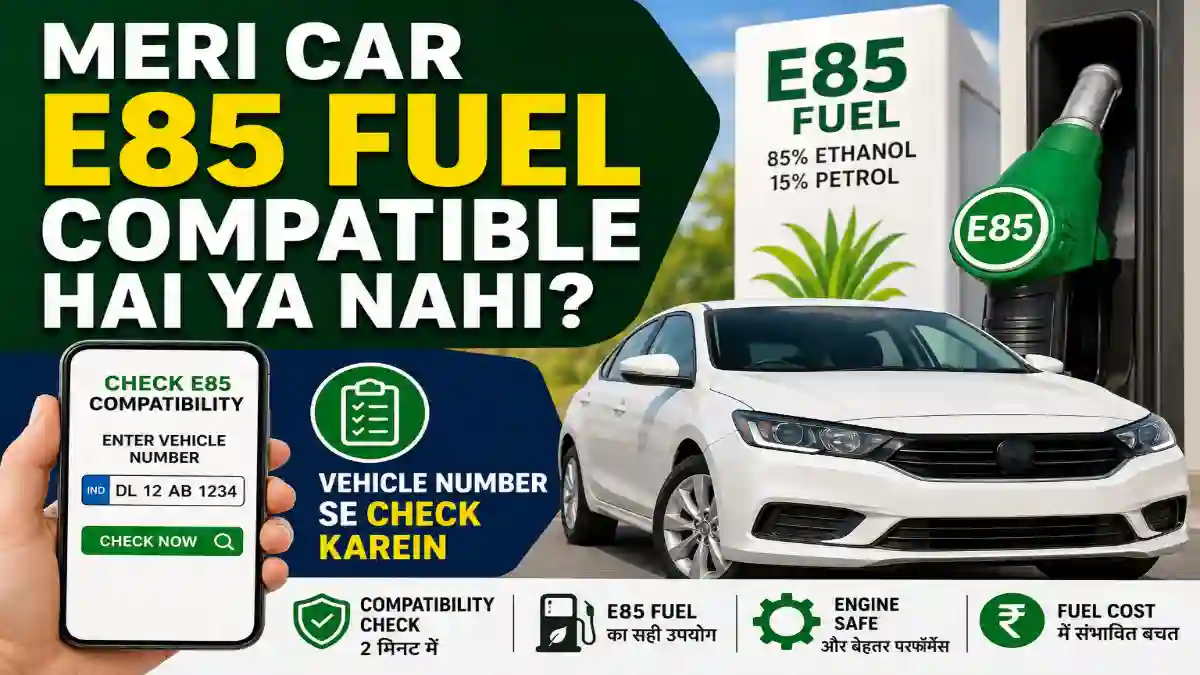
Checking whether your vehicle can safely handle E85 fuel using your registration number is a straightforward digital process. Follow these simple steps to verify your car's compliance:
- Step 1: Visit the official Vahan Parivahan website or open an authorized vehicle information mobile application.
- Step 2: Navigate to the 'Know Your Vehicle Details' section on the homepage.
- Step 3: Enter your car's registration number (e.g., DL3CXXXXXX) accurately without spaces.
- Step 4: Enter the captcha code displayed on the screen for security verification and click 'Search'.
- Step 5: Look closely at the "Fuel Type" and "Emissions/Norms" fields. If your vehicle is a certified Flex-Fuel Vehicle capable of running on high ethanol, it will be explicitly mentioned as "Flex-Fuel" or "E85 Compatible" in the registration data.
Alternatively, you can inspect your car physically. Check the inside of your fuel filler cap. Modern cars compatible with high ethanol blends carry a clear sticker denoting "E20", "E85", or "Flex-Fuel". You can also look up the Owner’s Manual or check the 17-digit Vehicle Identification Number (VIN); the eighth character of the VIN often denotes the engine type and fuel compatibility in modern cars.
What the Energy Experts Say About the E85 Transition
According to independent energy analysts and automobile experts, the shift to E85 is a double-edged sword for the current Indian market. Experts point out that while ethanol burns much cleaner than pure fossil petrol—thereby drastically reducing tailpipe emissions—it possesses a lower energy density. This means running a car on E85 can result in a minor drop in fuel mileage by about 15% to 25% compared to regular petrol.
"The success of E85 in India depends entirely on its pricing strategy," notes a senior energy analyst. "If OMCs price E85 significantly lower than the standard diesel price today and petrol price today, it will easily offset the mileage loss for the consumer. It becomes a win-win scenario for both the environment and the consumer's wallet."
Automotive engineers also warn against experimentation. Putting E85 into a standard BS4 or early BS6 engine that is only rated for E10 or E20 will quickly corrode fuel pumps and degrade plastic gaskets. Always rely on certified data from your vehicle number check before trying any new fuel variant at the pump.
Smart Fuel-Saving Tips for Smart Indian Consumers
While the country prepares for a wider rollout of alternative green fuels, managing your daily fuel expenses remains a priority. Here are some highly practical, expert-approved tips to extract maximum mileage from your current car:
- Maintain Optimum Tyre Pressure: Driving with under-inflated tyres increases rolling resistance, forcing your engine to consume more fuel. Check tyre pressure at least once a week.
- Drive with a Steady Foot: Avoid sudden acceleration and hard braking. Maintaining a steady speed between 60 km/h and 80 km/h on highways can improve fuel efficiency by up to 20%.
- Minimize Idle Time: If you are stuck at a traffic light that takes longer than 30 seconds, turn off your engine. Modern cars with auto start-stop technology do this seamlessly.
- Get Regular Servicing: Clogged air filters, old spark plugs, and dirty engine oil drastically reduce engine efficiency. Adhere to your manufacturer's service schedule strictly.
- Plan Your Trips Wisely: Combine multiple short errands into one single trip. Cold engines consume significantly more fuel during the first few kilometers of driving.
Future Outlook: What to Expect in the Fuel Market
Looking ahead, the fuel market news indicates a steady shift towards diversification. We are moving away from a petrol-only era into an era of multiple fuel choices, including EV, CNG, CBG (Compressed Bio-Gas), and various grades of Ethanol blends. The government aims to make E20 petrol uniformly available across India, while simultaneously setting up dedicated corridors for E85 and Flex-Fuel transport vehicles.
In the short term, standard retail petrol and diesel prices are expected to remain tightly bound to international crude benchmarks and OPEC+ production policies. However, as domestic ethanol production from sugarcane surplus and agricultural waste scales up, supply shocks will minimize.
For car buyers, the message from the industry is loud and clear: if you are planning to purchase a new vehicle, look closely at its future-proofing capabilities. Opting for vehicles with explicit flex-fuel compliance will ensure that you stay immune to future fossil fuel scarcity and high pricing cycles.
Conclusion
Checking your car's E85 compatibility using your vehicle number is a quick and effective way to safeguard your engine before trying new alternative fuels. As India marches toward a cleaner energy future, staying updated with daily fuel shifts ensures you make informed, cost-effective, and safe driving decisions.