Introduction
The Indian fuel market is standing on the edge of a major green revolution. For years, the average middle-class commuter has felt the pinch of volatile oil markets every time they checked the petrol price today or diesel price today. However, a brand-new alternative has officially arrived.
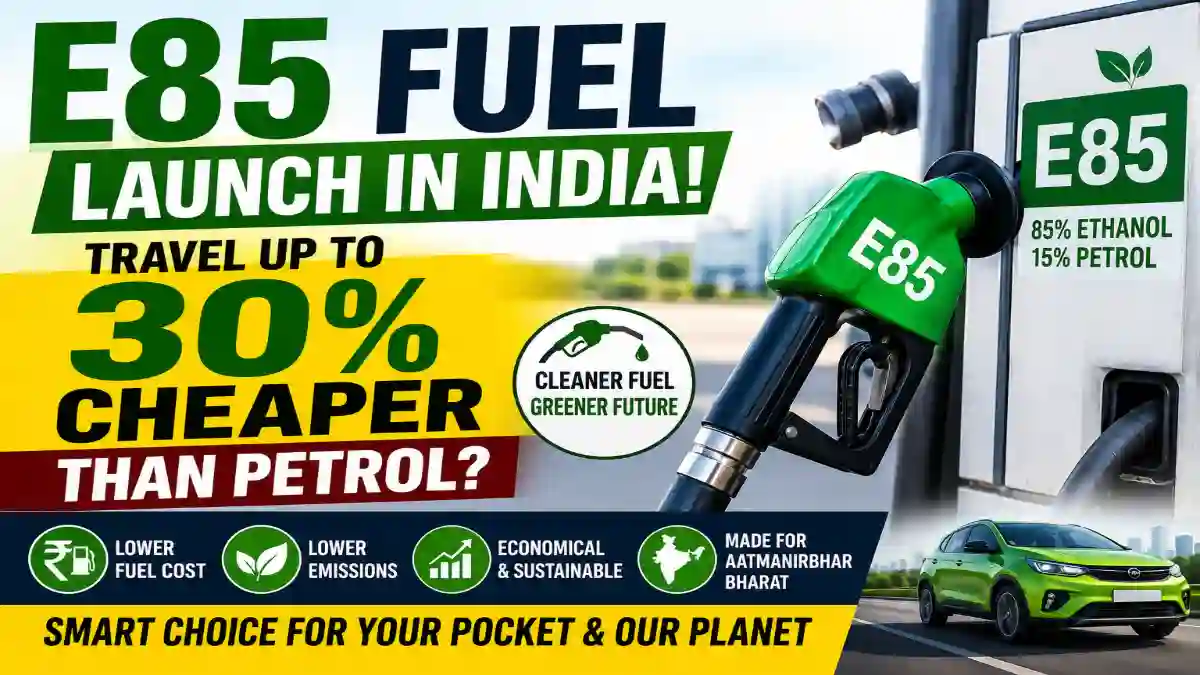
Union Minister for Petroleum and Natural Gas, Hardeep Singh Puri, alongside Union Minister Nitin Gadkari, recently unveiled India's first mass-market Flex-Fuel Vehicles (FFVs) and announced the phased rollout of E85 fuel at select Indian Oil outlets. This historic fuel price in India update promises an alternative that could potentially make your daily commute up to 30% cheaper. But is it really as simple as a cheaper price tag at the pump, or is there a catch hidden in the mileage math? Let us dive deep into the reality of the E85 fuel launch.
Crude Oil Se Azadi: Kyun Badal Raha Hai India Ka Fuel Market?
The main reason behind introducing E85 is India's heavy dependence on imported energy. Currently, India imports about 89% of its crude oil requirement. This makes the domestic economy highly sensitive to fuel market shocks, global crude oil price fluctuations, and shipping disruptions caused by international geopolitical tensions.
To protect Indian consumers from these price spikes, the government has aggressively pushed its Ethanol Blending Program. India has already successfully achieved a nationwide 20% ethanol blend baseline (E20). The shift to E85—which consists of 85% domestically produced ethanol and just 15% conventional petrol—is the logical next step. Because ethanol is distilled locally from agricultural feedstocks like sugarcane and damaged food grains, it costs significantly less to produce than importing crude oil. This domestic surplus is exactly what allows the government to price the new fuel alternative substantially lower than standard unleaded options.
The Petrol Pocket-Pinch: What E85 Means for Daily Commuters
When we look at the immediate economic impact on common motorists, E85 presents a fascinating balance of lower upfront costs vs. operational efficiency. It is important to clarify that E85 cannot be poured directly into your existing standard petrol car or motorcycle. Doing so would corrode regular engine components and cause severe mechanical failure.
To use E85, you need a certified Flex-Fuel Vehicle (FFV). Major manufacturers are already leading the charge; Hero MotoCorp recently launched flex-fuel variants of its highly popular Splendor Plus and HF Deluxe motorcycles, while Maruti Suzuki has showcased its mass-market WagonR FFV.
The absolute best part of this shift for the everyday commuter is the relief from a sudden petrol price hike. Because ethanol pricing is governed locally and tied to agricultural MSPs (Minimum Support Prices) rather than global crude oil indices, the retail price of E85 remains highly stable. For the millions of two-wheeler riders across India, switching to a locally produced biofuel blend means their weekly transit budget will no longer be held hostage by OPEC production cuts or shipping line disruptions.
The Ground Reality: Which Indian Cities Are Getting E85 Pumps First?
The commercial rollout of E85 fuel is following a highly strategic, corridor-based path before it goes completely nationwide. The initial phase focuses heavily on major industrial hubs and metropolitan cities.
- Delhi-NCR: The national capital is leading the deployment, with initial dispensing stations opening up along major transit corridors.
- Mumbai & Pune: Given Maharashtra's status as a top sugarcane-producing state, the Mumbai-Pune-Nagpur corridor is receiving a dense network of early E85 fuel stations.
- Bengaluru: Karnataka's tech hub is quickly preparing its retail network to support both expanding EV fleets and incoming flex-fuel commuter bikes.
- Chennai & Kolkata: These coastal metros will see initial pilot stations expand rapidly as local state oil boards align their supply lines with regional ethanol distilleries.
According to official ministry timelines, the initial footprint of 50 to 100 dispensing stations across these core regions is projected to scale up to 500 outlets by December 2026, with an ultimate target of 5,000 operational stations serving major Indian cities by the end of next year.
Setting Up the Pumps: How the Government and OMCs are Deploying E85
Oil Marketing Companies (OMCs) like Indian Oil Corporation Limited (IOCL), Bharat Petroleum (BPCL), and Hindustan Petroleum (HPCL) are working hand-in-hand with the Ministry of Petroleum and Natural Gas to build out the required logistical pipeline. Setting up E85 infrastructure requires completely dedicated underground storage tanks and high-flow, corrosion-resistant dispensing units at local pumps, as ethanol absorbs moisture much faster than standard petrol.
Concurrently, the government is looking closely at fuel-price support mechanisms and specialized tax structures to keep E85 highly competitive. By shifting demand away from foreign oil to domestic bio-refineries, the state has already saved over ₹1.84 lakh crore in foreign exchange. A portion of these immense national savings is being utilized to keep biofuel retail rates highly attractive for early adopters.
The Fuel Math: Energy Density vs. Your Wallet
To truly judge if E85 can make your travel 30% cheaper, we have to look closely at the "70% Rule" popularized by Brazil—the undisputed global leader in flex-fuel technology.
The Ethanol Efficiency Paradox: Ethanol has a lower energy density than pure petrol. This means an engine needs to burn roughly 20% to 30% more fuel by volume to cover the exact same distance.
Therefore, a vehicle running on E85 will see a noticeable drop of 20-30% in its standard mileage compared to running on pure petrol.
Because of this mileage drop, the financial math only works in your favor if the retail pump price of E85 is kept significantly lower than standard petrol. If regular petrol is priced at ₹100 per litre, E85 needs to be priced at or below ₹70 per litre for a consumer to experience true, real-world savings on a cost-per-kilometre basis.
Fortunately, the Indian government has openly acknowledged this economic factor. Minister Puri explicitly stated that "consumer economics is the most important factor," confirming that E85 will be heavily incentivized to sit well below the standard E20 and regular petrol pricing thresholds to ensure immediate cost parity and long-term savings for Indian families.
The Smarter Move: Your Step-by-Step Transition Plan
If you are planning to buy a new vehicle soon and want to minimize your long-term commuting costs, here is a practical roadmap to help guide your decision:
- Evaluate Your Daily Running: If your daily travel is high and you live within the initial Delhi-NCR, Mumbai, Pune, or Bengaluru corridors, a Flex-Fuel Vehicle is highly worth considering.
- Factor in the Upfront Premium: Keep in mind that flex-fuel variants carry a small premium over regular models due to upgraded fuel injectors, ethanol sensors, and anti-corrosive fuel lines. For example, the flex-fuel Hero Splendor Plus costs about ₹5,150 more than the standard petrol version. Calculate how quickly your fuel savings will offset that initial amount.
- Track Your Local Pump Updates: Keep a close eye on a trusted local platform like TodayPetrolPrice.in for a real-time CNG price update or regional E85 availability charts before mapping out long-distance road trips.
Conclusion
The launch of E85 fuel is a huge step towards making India self-reliant in terms of energy needs. Although it is a technical fact that the use of ethanol reduces fuel efficiency (mileage) by 20% to 30%, the government has decided to keep the price of this green fuel much lower than conventional petrol, making it a very economically viable option. With the growing adoption of electric vehicles (EVs) in India and stable fuel prices, car and bike buyers now have realistic and budget-friendly options to get relief from rising petrol prices.