Introduction
For daily commuters in the National Capital Region (NCR), the borders are almost invisible. You might wake up in Noida, travel through Delhi for work, and head to Gurgaon for an evening meeting. While state boundaries may blur during everyday commutes, your wallet takes a big hit every time you arrive at a fuel station. Due to different tax structures imposed by districts in neighbouring states, even a distance of just a few kilometres can change how much you pay to refuel your vehicle.
If you're looking to cut down on your monthly expenses, knowing where to buy your fuel can be a huge financial advantage. Let's take a look at the latest fuel rates in Delhi, Noida and Gurgaon so that you can plan your 'pitstops' wisely.
What Drives the Daily Fluctuations in NCR Fuel Rates
If you have been tracking the fuel market news lately, you know that Indian fuel stations have seen a fair share of price revisions. Retail fuel pricing in India operates under a dynamic model, meaning prices can be adjusted daily at 6:00 AM based on international crude oil benchmarks and the Rupee-to-Dollar exchange rate.
The primary driver behind the recent volatility is the tense geopolitical situation in West Asia, which has disrupted major shipping lanes like the Strait of Hormuz. Because India relies on imports for over 85% of its crude oil needs, global supply shocks translate directly into domestic pricing pressure.
However, the reason fuel costs differ so vastly between Delhi, Uttar Pradesh (Noida), and Haryana (Gurgaon) boils down to local governance. While the Central Government imposes a uniform excise duty across the country, each state applies its own Value Added Tax (VAT) and local cess. This state-level tax variance is exactly why a single litre of fuel carries three different price tags within the same metropolitan area.
How NCR's Price War Knocks Your Monthly Pocket
When a petrol price hike hit the country recently, it sent ripples through the household budgets of millions of NCR residents. For a regular car owner driving 40 to 50 kilometers daily across the border, an extra two or three rupees per litre adds up to thousands of rupees by the end of the year.
The impact is even more severe for diesel vehicle owners, who generally run commercial fleets, SUVs, or long-distance logistics vehicles. Because diesel drives the transport industry, any shift in its rate directly triggers inflationary pressures on everyday items, from vegetables entering the local mandis to online e-commerce deliveries. Securing even a minor discount per litre by cross-border refueling can help regular drivers protect their monthly savings.
State-Wise Situation: The NCR Fuel Showdown
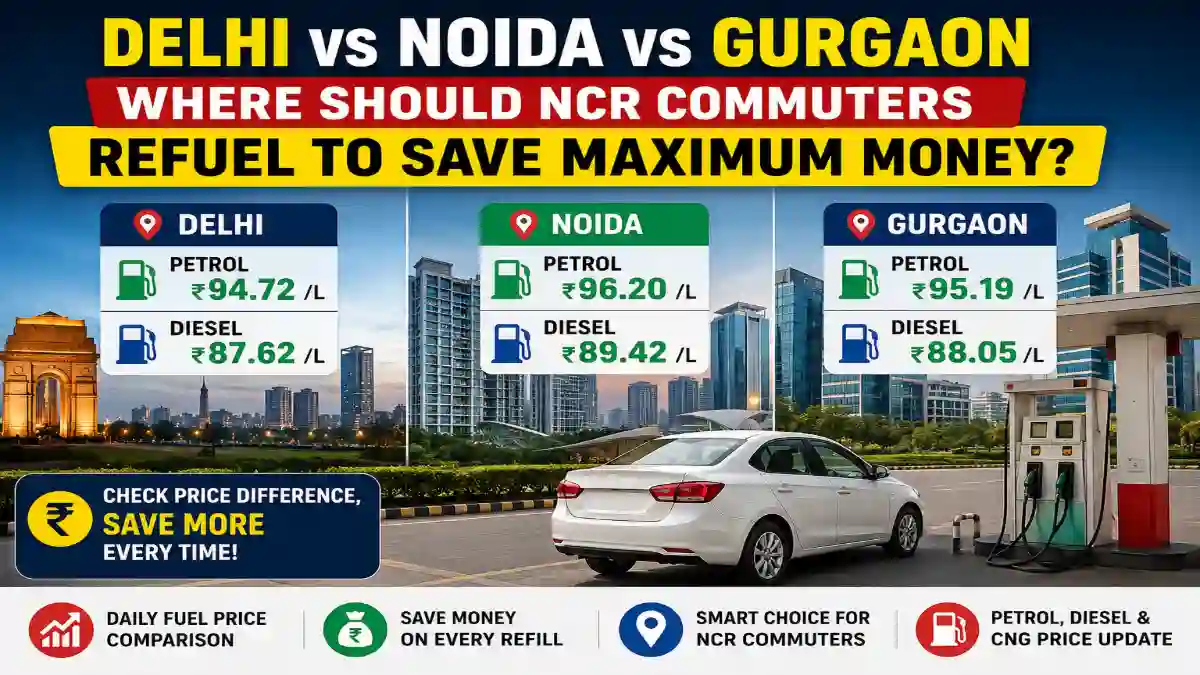
To understand exactly where you save the most, let us look at the real-time rates recorded across the borders. Currently, the pricing dynamics between the three hubs present an interesting pattern for petrol, diesel, and CNG consumers.
The Fuel Price Matrix (Delhi NCR vs. Major Metros)
City / Region | Petrol Price Today (per L) | Diesel Price Today (per L) | CNG Price Update (per Kg) |
|---|---|---|---|
New Delhi | ₹102.12 | ₹95.20 | ₹83.09 |
Noida (UP) | ₹101.93 | ₹95.42 | ₹91.70 |
Gurgaon (Haryana) | ₹102.85 | ₹95.64 | ₹88.12 |
Mumbai (Reference) | ₹111.21 | ₹97.83 | ₹86.00 |
Kolkata (Reference) | ₹113.51 | ₹99.82 | ₹93.50 |
Bengaluru (Reference) | ₹110.93 | ₹98.80 | ₹95.00 |
Looking at the core NCR numbers, we can draw clear conclusions for your daily travel strategy:
- For Petrol Cars: Noida holds the crown for the cheapest petrol at ₹101.93 per litre, closely followed by Delhi at ₹102.12. Gurgaon turns out to be the most expensive zone to fuel a petrol vehicle, charging ₹102.85 per litre.
- For Diesel Cars: If you drive a diesel vehicle, Delhi is your best bet at ₹95.20 per litre. Noida stands slightly higher at ₹95.42, while Gurgaon sits at the top of the cost ladder at ₹95.64.
- For CNG Vehicles: The difference here is massive. Delhi offers CNG at an incredibly low rate of ₹83.09 per kg. In comparison, if you fill up your tank in Noida, you pay a steep premium at ₹91.70 per kg—a massive difference of over ₹8.60 per kilo!
Government and OMC Role
Retail prices are monitored and adjusted by state-run Oil Marketing Companies (OMCs) like Indian Oil Corporation Limited (IOCL), Bharat Petroleum Corporation Limited (BPCL), and Hindustan Petroleum Corporation Limited (HPCL).
When global crude prices spike, OMCs face a delicate balancing act. Passing the entire cost burden to consumers can shock the economy, which is why they occasionally absorb temporary losses. However, when market pressures remain high for months, step-by-step price corrections become unavoidable. Once the OMCs set the base price, the state governments apply their local VAT formulas, widening the price gap between neighboring cities like Delhi and Gurgaon.
Expert View
"Commuters in the NCR enjoy a unique geographical advantage," says Arvind Pal, Fuel Market Analyst. "Because Delhi, Haryana, and Uttar Pradesh sit tightly adjacent to each other, a driver can easily save ₹50 to ₹150 on a single full tank tank-up simply by planning where to stop. While the differences look like mere paise on paper, they alter long-term running economics—especially for heavy CNG users or commercial transport fleets operating daily out of Noida or Ghaziabad into Delhi."
What Consumers Should Do to Maximize Savings
To extract the highest mileage out of your money in the NCR, follow these strategic refueling rules:
- Map Your Fuel to the Right Territory: If you drive a CNG vehicle, make it an absolute rule to fill your tank before exiting Delhi borders. Avoid buying CNG in Noida or Gurgaon unless it is an emergency.
- Align Petrol Trips to UP: If your workplace or home is near Noida or Ghaziabad, use those fuel stations for your petrol cars to take advantage of the lower state VAT.
- Leverage Co-Branded Fuel Cards: Pair your geographic choices with credit cards or digital wallets linked directly to OMCs (like fuel-branded variants from major banks) to rack up 2% to 5% back in cash-equivalent fuel points.
- Monitor Your Commute Efficiency: Do not drive 10 kilometers out of your way just to save 50 paise per litre, as you will burn off the financial advantage in stop-and-go traffic. Only divert if the fuel station falls directly along your regular route.
Conclusion
Managing your monthly transportation budget requires a blend of smart driving habits and awareness of current market rates. Within the NCR, Delhi serves as the undisputed haven for CNG and diesel users, while Noida offers a gentle relief for petrol vehicle owners. By keeping an eye on the shifting numbers and planning your tank fillings around these borders, you can keep your hard-earned money right where it belongs—in your pocket.