Introduction
Buying a car in India used to be a simple decision. You either chose petrol for low monthly usage or diesel if your running was high. However, the Indian automotive market has changed drastically. With diesel cars rapidly disappearing from the small and mid-size segments, car buyers are left with three primary choices: Petrol, Compressed Natural Gas (CNG), and Electric Vehicles (EVs).
If you are a daily commuter driving around 50 kilometers every day, choosing the wrong vehicle type can heavily damage your monthly budget. With the petrol price today hovering at record highs and recent changes in the energy sector, finding the sweet spot between upfront purchase cost and daily running expenses requires an in-depth calculation. This detailed guide breaks down the math to help you choose the best option for your daily 50km travel.
Crude Oil vs Geopolitical Tension: Why Fuel Prices Are Fluctuating in India?
The fuel market news in India has been highly volatile recently. In the past few weeks, global crude oil fluctuations driven by geopolitical tensions in the Middle East have put immense pressure on domestic oil companies. State-run Oil Marketing Companies (OMCs) have had to adjust their margins, which directly affects the fuel price in India.
Petrol and diesel prices are not the only ones fluctuating If you are tracking the CNG position updates for May and June, major gas distribution companies like Indraprastha Gas Limited (IGL) and Mahanagar Gas Limited (MGL) have recently increased CNG prices by ₹2 per kg in major cities. This sudden rise in the position of alternative fuels is happening because domestic gas supply quotas are decreasing, forcing companies to rely on more expensive imported liquefied natural gas (LNG). On the other hand, there are some variations in the power supply for EV traffic in different states.
How High Petrol Prices Ruin Your Monthly Middle-Class Budget
A significant petrol price hike heavily impacts a middle-class household budget. When a basic fuel costs anywhere between ₹102 to ₹111 per litre depending on your location, a daily 50km commute means you are burning roughly 3 to 4 litres of fuel every single day, assuming an average city mileage of 13-15 km/l.
This translates to a daily expense of around ₹350 just for fuel. Over a year, this amount easily crosses ₹1.2 lakh. Because of this high recurring expense, commuters are actively shifting away from conventional petrol engines. While diesel price today remains slightly lower than petrol, the high registration costs, shorter 10-year lifespan restrictions in regions like Delhi-NCR, and stricter emission norms make diesel highly impractical for compact daily commuters.
Metro City Fuel Check: Petrol, EV, and CNG Rates Compared
The final math changes depending on where you live because fuel taxes vary across states. Here is a quick look at how the petrol price today and recent CNG rates look across major metros:
- Delhi: Petrol stands at ₹102.12 per litre, while CNG is relatively cheaper at ₹83.09 per kg. Delhi offers excellent infrastructure for EVs and low EV charging tariffs.
- Mumbai: Residents face a steeper cost, with petrol retailing at ₹111.21 per litre and CNG priced at ₹86.00 per kg.
- Bengaluru: Petrol is priced high at ₹110.91 per litre, and CNG costs around ₹95.00 per kg, making EVs highly attractive here.
- Chennai: Petrol retails at ₹107.77 per litre, while CNG touches ₹95.00 per kg.
- Kolkata: Petrol costs around ₹113.47 per litre, while CNG sits at ₹93.50 per kg.
Government and OMC Role
The Indian government is pushing heavily for a transition toward cleaner energy. While high Central Excise and State VAT continue to keep petrol expensive, subsidies and lower GST rates (just 5% on EVs compared to 28% on petrol vehicles) are being used to encourage buyers to go electric.
Oil Marketing Companies are also transforming their fuel stations into multi-energy hubs. You will now see EV fast-charging stations and expanded CNG bays alongside traditional petrol pumps. However, OMCs still face marketing losses due to international crude oil pressure, meaning sudden adjustments in retail fuel rates can happen at any time.
Expert View: The 5-Year Financial Breakdown
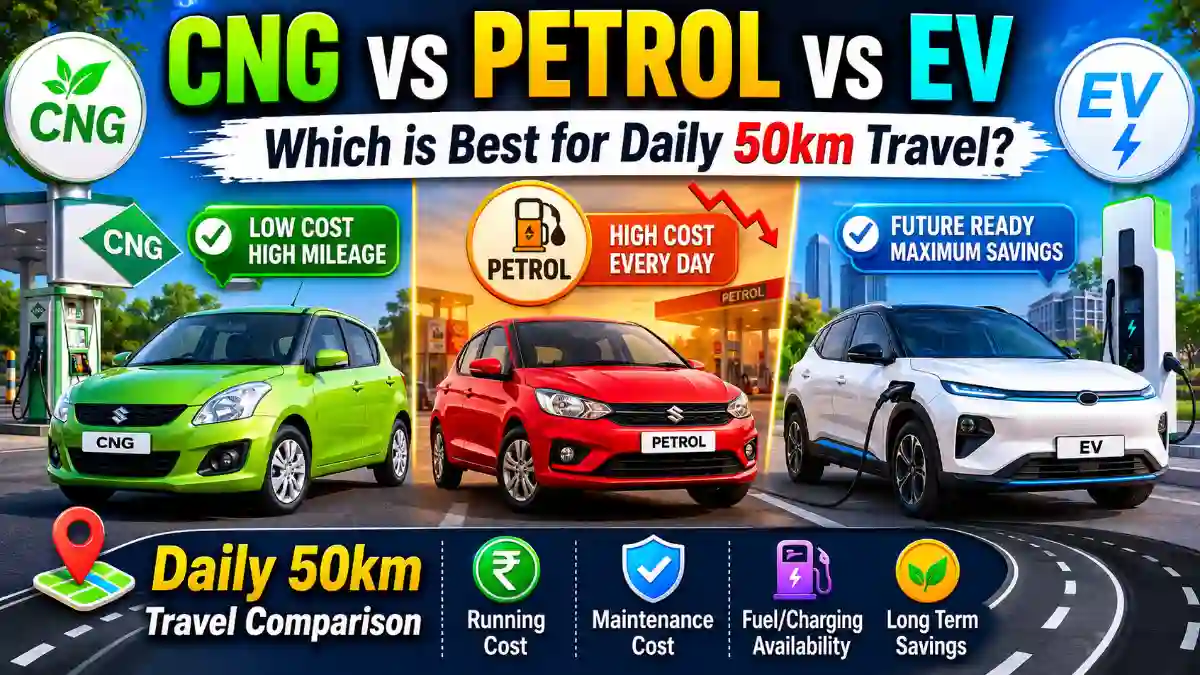
To find out which fuel type fits a daily 50km run best, let us look at a realistic 5-year calculation. We will compare a standard petrol car, a factory-fitted CNG variant, and a mid-range Electric Vehicle (assuming 300 days of driving per year, totaling 15,000 km annually).
Metric | Petrol Car | CNG Car | Electric Vehicle (EV) |
|---|---|---|---|
Average Initial Car Cost | ₹8,50,000 | ₹9,50,000 | ₹11,50,000 |
Average Mileage / Efficiency | 14 km/litre | 22 km/kg | 8 km/unit (kWh) |
Average Fuel / Energy Cost | ₹105 per litre | ₹88 per kg | ₹8 per unit |
Per Kilometer Running Cost | ~₹7.50 | ~₹4.00 | ~₹1.00 |
Annual Running Cost (15k km) | ₹1,12,500 | ₹60,000 | ₹15,000 |
5-Year Total Running Cost | ₹5,62,500 | ₹3,00,000 | ₹75,000 |
Looking closely at this math, an EV saves you nearly ₹4,87,500 in fuel costs over five years compared to a petrol car. This easily recovers the higher initial premium you pay for an electric vehicle. CNG also emerges as a very strong middle ground, saving you more than ₹2.6 lakh over petrol.
What Consumers Should Do
Your decision should depend on your specific setup, budget, and region:
- Choose Petrol If: Your monthly driving is low (less than 800 km total) and you only occasionally hit the 50km mark. The lower initial cost of a petrol vehicle does not justify paying extra for CNG or EV tech unless your usage is consistently high.
- Choose CNG If: You have a fixed budget under ₹10 lakh, want low running costs, and have reliable CNG stations nearby. Be prepared to lose some boot space for the gas cylinder and expect short queues at the pumps during peak hours.
- Choose EV If: You drive 50km or more consistently every day, have a dedicated parking spot at home to set up a standard AC charger, and can expand your budget to ₹11-12 lakh. With options like the Battery-as-a-Service (BaaS) model gaining ground in India, upfront EV costs are becoming much more accessible.
Conclusion
For a daily 50km commute in India, Electric Vehicles (EVs) emerge as the absolute winner for long-term savings, ease of automatic driving in heavy traffic, and ultra-low running costs. However, if home charging setup is an issue or your budget is tight, a CNG car serves as an excellent, highly economical alternative. Conventional petrol cars are increasingly difficult to justify as daily commuters under current economic conditions, unless your daily driving drops significantly.