Introduction
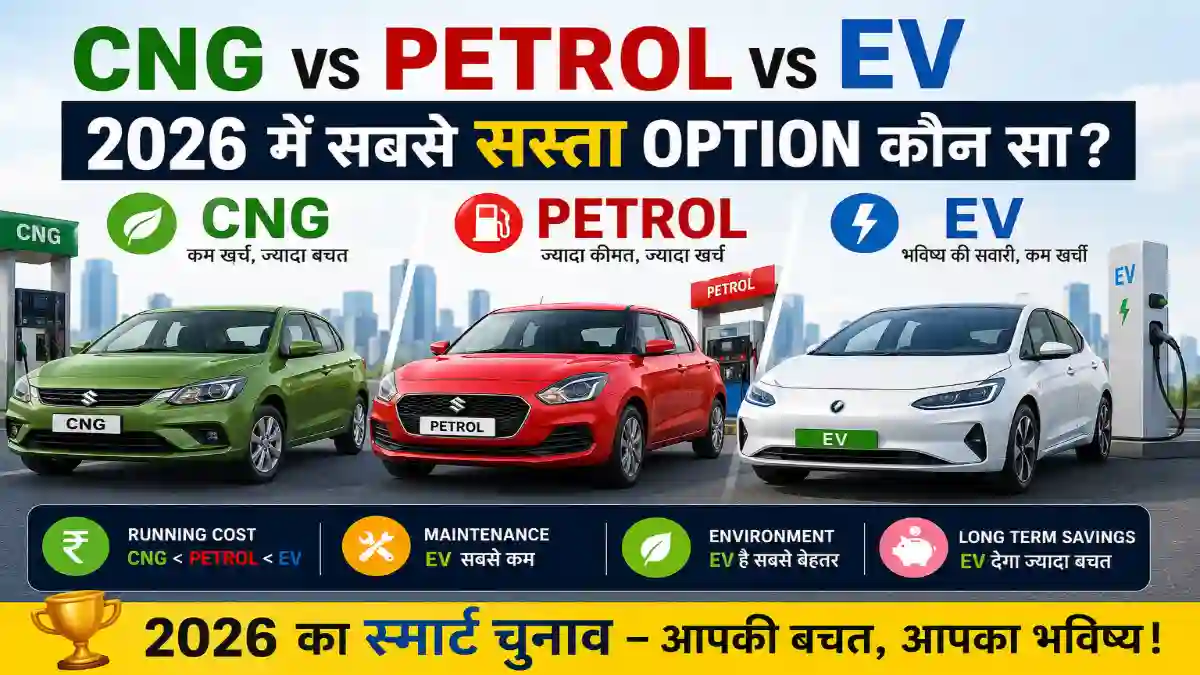
Indian car buyers are currently facing a major dilemma. With the fuel price in India fluctuating due to international tensions and domestic revisions, picking the right vehicle has become a direct mathematical puzzle for our monthly budgets. If you are planning to buy a new car or looking to upgrade your commute this year, the big question on your mind is bound to be: CNG, Petrol, ya EV — 2026 mein sabse sasta option kaun sa hai?
Choosing the wrong fuel type can cost you thousands of extra rupees every month. To solve this confusion for you, we have broken down the calculations, upfront costs, and daily running expenses of all three options based on the latest fuel market news and ground realities in India.
Why Fuel Prices Are Changing
The Indian fuel market has experienced significant volatility in recent weeks. A major driver behind this instability is the ongoing geopolitical tension in West Asia, which briefly pushed global Brent crude oil prices above $105 per barrel. While international updates suggest a temporary plateau near $93 a barrel due to preliminary ceasefire talks, domestic fuel prices remain highly sensitive to these global micro-adjustments.
For alternative options like compressed natural gas, the pricing structure is linked to a government-administered mechanism that accounts for domestic production costs and global benchmarks. Because India imports a vast majority of its energy resources, even slight disruptions along global shipping lanes cause immediate ripples at your local retail outlet.
Petrol and Diesel Price Impact
When a petrol price hike or a sudden change in gas rates hits the market, the impact on entry-level car buyers and daily commuters is immediate. According to recent data from leading automobile manufacturers, even a ₹10 jump in fuel prices adds roughly ₹1,000 to ₹1,500 to a middle-class family's monthly budget.
This persistent pressure is forcing urban commuters to completely shift how they calculate vehicle ownership. Daily office-goers in heavily congested tier-1 and tier-2 cities are increasingly realizing that standard combustion engines lose significant efficiency in bumper-to-bumper traffic, making a direct transition to CNG or electric mobility highly attractive.
State-wise Situation
Fuel rates vary significantly across India due to localized Value Added Tax (VAT) and freight charges applied by individual state governments. To keep your calculations precise, here is a breakdown of the retail rates for a petrol price today, diesel price today, and the latest CNG price update across major Indian metros as of late May 2026:
| Metro City | Petrol Price Today (per Litre) | Diesel Price Today (per Litre) | CNG Price Today (per Kg) |
|---|---|---|---|
| New Delhi | ₹102.12 | ₹95.20 | ₹83.09 |
| Mumbai | ₹111.21 | ₹97.83 | ₹86.00 |
| Bengaluru | ₹110.89 | ₹98.80 | ₹95.00 |
| Chennai | ₹108.01 | ₹99.78 | ₹95.00 |
| Kolkata | ₹113.51 | ₹99.82 | ₹93.50 |
Note: EV charging costs vary between ₹8 to ₹15 per unit (kWh) at public fast-charging stations, and roughly ₹6 to ₹9 per unit for residential setups across these states.
Government and OMC Role
Oil Marketing Companies (OMCs) like Indian Oil, Bharat Petroleum, and Hindustan Petroleum adjust retail rates based on a combination of international crude fluctuations, currency exchange rates, and local taxes. While the daily pricing model remains active, retail prices frequently experience brief stabilization periods depending on domestic market interventions and state assembly transitions.
On the clean energy front, the Union Government is actively steering consumers toward green powertrains using structural initiatives. The introduction of the PM E-DRIVE incentive program (which succeeded the older FAME schemes) heavily slashes the tax burden on electric cars by capping GST at just 5%, compared to a heavy 28% GST plus additional cess levied on standard petrol vehicles.
Expert View: The Per-Kilometre Math
To determine which option is truly the cheapest in 2026, let us look strictly at the real-world operating economics. Analysts use a simple benchmark: Cost Per Kilometre (CPK).
1. Petrol Cars (The Traditional Benchmark)
- Average Mileage: 14 to 16 km/l in normal city traffic.
- Fuel Cost: Taking an average price of ₹105 per litre.
- Running Cost: Approximately ₹6.50 to ₹7.50 per km.
2. CNG Cars (The Practical Budget Champion)
- Average Mileage: 22 to 25 km/kg.
- Fuel Cost: Taking an average price of ₹88 per kg.
- Running Cost: Approximately ₹3.50 to ₹4.00 per km.
3. Electric Vehicles (The Lowest Running Cost)
- Average Efficiency: Around 8 to 10 km per unit (kWh) of electricity.
- Charging Cost: Average of ₹8 per unit (mixing home and public charging).
- Running Cost: Approximately ₹0.80 to ₹1.20 per km.
Expert Analysis: While EVs win the running cost battle by an absolute landslide, users must factor in the "upfront premium." However, the introduction of innovative Battery-as-a-Service (BaaS) models by prominent car manufactures in 2026 has decoupled the high battery cost from the vehicle price. This brings the initial on-road cost of an EV almost at par with standard petrol variants, altering the financial payback period entirely in favor of electric mobility.
What Consumers Should Do
Your final choice shouldn't just depend on fuel prices; it should match your specific driving patterns. Here is an actionable roadmap to help you decide:
- Choose Petrol if: Your monthly running is very low (less than 800 km per month) or your usage is limited to occasional weekend drives. The lower upfront cost of a petrol car makes financial sense here, as you won't drive enough to recover the premium cost of an EV or CNG kit.
- Choose CNG if: Your daily running is high (40 to 80 km), you live in a city with a dense network of gas stations (like Delhi NCR or Mumbai), and you frequently travel to areas where EV charging infrastructure is still developing. Be ready to compromise on boot space due to the cylinder.
- Choose EV if: You drive more than 50–60 km daily inside the city, have a dedicated parking spot to install a home charger, and want the absolute lowest per-kilometre operational cost without dealing with long queues at CNG stations.
Conclusion
In 2026, the crown for the absolute cheapest running cost goes to Electric Vehicles (EVs), especially with the arrival of BaaS frameworks that lower purchase costs. However, for buyers who lack dedicated home charging infrastructure or frequently undertake long, unplanned inter-state journeys, CNG remains the most reliable and budget-friendly alternative to combat high petrol prices. Assess your monthly mileage, check your local infrastructure, and pick the one that shields your wallet best against future market hikes.